
🏥 How to Choose a Stem Cell Clinic Abroad
A modern facility, an impressive treatment package, and dozens of positive testimonials can make an international stem cell clinic appear credible.
But presentation is not proof. Before traveling for stem cell therapy abroad, you need to determine whether the treatment is appropriate for your condition.
Whether the treatment is supported by meaningful evidence, produced under reliable quality controls, and delivered by qualified medical professionals.
You also need to know what happens if the treatment does not work or if a complication develops after you return home.
This is particularly important because the term “stem cell therapy” can describe very different interventions.
It may refer to an established hematopoietic stem cell transplant, an authorized cell-based medicine, an intervention being evaluated in a legitimate clinical trial, or a commercially marketed treatment that has not been adequately tested.
The International Society for Stem Cell Research (ISSCR) notes that proven stem cell treatments remain limited and that many other applications are still experimental.
It recommends examining the evidence, regulatory oversight, physician expertise, cell source, consent process, risks, follow-up plan, and costs before proceeding.¹
Let's dive deeper into a practical framework for evaluating those factors.
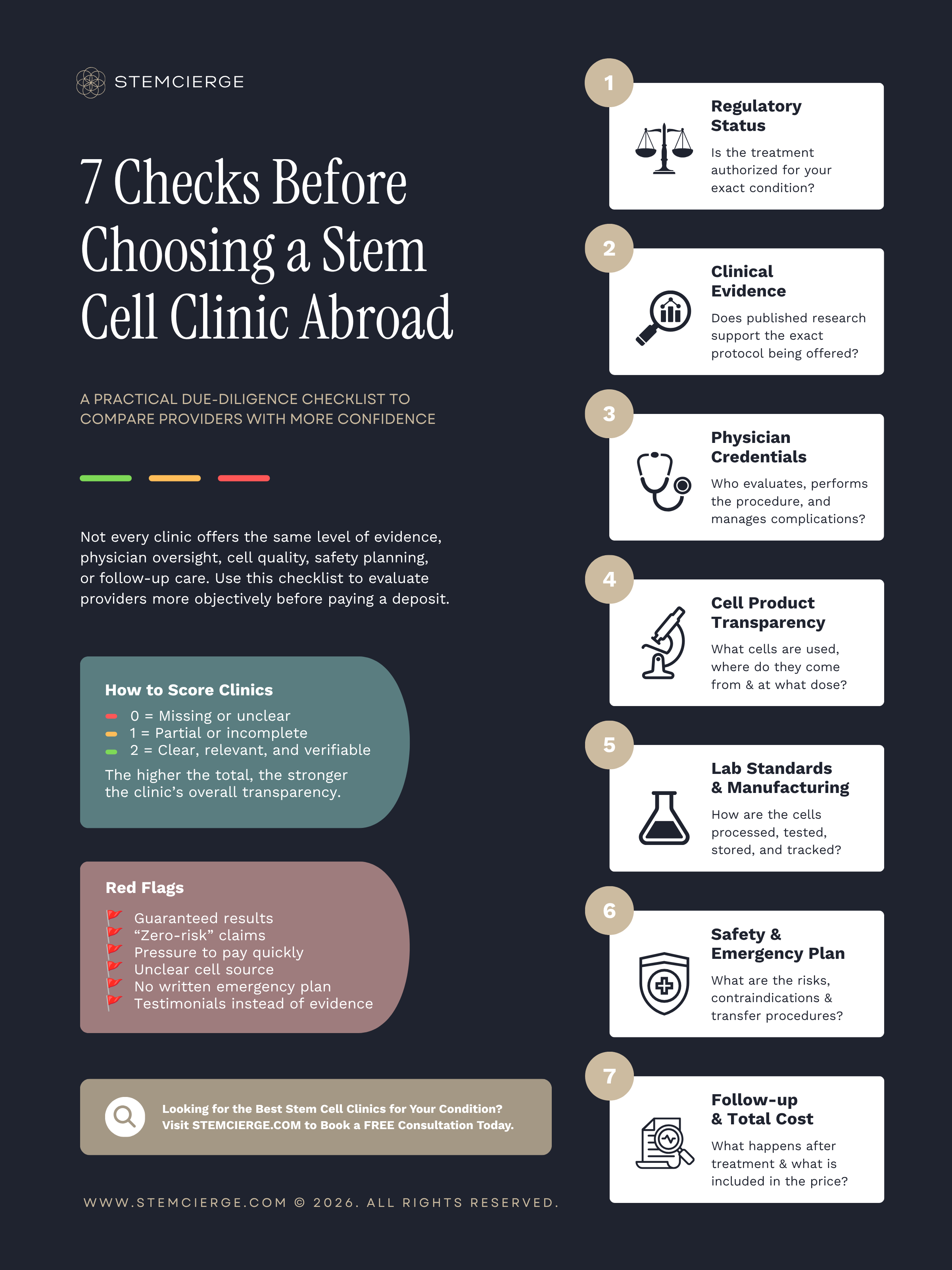
🌐 The 7 questions to ask a stem cell clinic, at a glance:
- Is this stem cell treatment authorized for my exact condition?
- What evidence supports this specific stem cell protocol?
- Who will evaluate and treat me?
- What type of stem cells or biological product will I receive?
- How are the cells manufactured and tested?
- What are the risks and emergency procedures?
- What follow-up care, outcome tracking, and total costs are included?
A credible clinic should answer these questions clearly, in writing, and without pressuring you to make an immediate financial decision.
🔍 Before You Compare Clinics: What Kind of Stem Cell Treatment Is Being Offered?
One of the first challenges is determining whether the clinic is offering an approved treatment, a clinical trial, or a commercially available experimental intervention.
These are not interchangeable categories.
☑️ Approved & Authorized Stem Cell Treatment
An authorized treatment has been evaluated by a national or regional regulator for a defined use.
That authorization normally applies to a particular:
- Product
- Patient population
- Medical condition
- Dose
- Delivery method
- Manufacturing process
Approval for one application does not validate the same cells for every other disease.
For example, the FDA approved Ryoncil in 2024 as a bone-marrow-derived mesenchymal stromal cell therapy for a narrowly defined group of pediatric patients with steroid-refractory acute graft-versus-host disease.
That does not mean the product, or mesenchymal stromal cells in general, has been approved for arthritis, spinal injuries, neurological conditions, autoimmune diseases, or longevity treatments.³
🧬 Experimental Stem Cell Intervention
A clinical trial is a structured research study designed to answer specific questions about safety, dosage, or effectiveness.
The treatment being studied is still unproven. Participation does not guarantee that the intervention will work or be superior to existing care.
A legitimate trial should normally have:
- A defined research protocol
- Clear eligibility criteria
- Ethics committee approval
- Regulatory authorization where required
- Predefined clinical outcomes
- Adverse-event monitoring
- Transparent information about funding and patient costs
A listing on ClinicalTrials.gov or another registry can be useful.
But it is not proof that the study has been endorsed by the registry, reviewed by every relevant regulator, or shown to be effective.
The ISSCR specifically warns that not every study listed in a trial database is necessarily regulated, legitimate, or endorsed.¹
🔬 Legitimate Stem Cell Clinical Trial
Some clinics sell experimental treatments outside formal clinical trials.
That does not automatically make a treatment fraudulent or unsafe.
Medical innovation often begins before definitive evidence is available.
However, the uncertainty should be presented honestly.
The treatment should still have a reasonable scientific rationale, independent oversight, documented manufacturing controls, and a robust informed-consent process.
The problem begins when an experimental intervention is marketed as established medicine.
1️⃣ Is the Stem Cell Treatment Authorized for My Exact Condition?
The first question is not simply whether the clinic is legally operating.
You need to know whether the specific cellular product and treatment protocol are authorized for your particular condition.
A clinic may have a business license, hospital registration, laboratory certificate, or permission to conduct medical procedures.
None of these necessarily proves that the stem cell product itself has been reviewed for the proposed use.
❓ Questions to ask the stem cell clinic
- Which national or regional authority regulates this treatment?
- Is the product authorized for my exact diagnosis?
- What is the authorization or registration number?
- Can I verify that number through an independent government database?
- Is the treatment being provided as standard care, a clinical trial, compassionate use, hospital exemption, or another pathway?
- Which ethics committee reviewed the protocol?
- When was the approval granted, and when does it expire?
- Does the approval apply to this clinic and manufacturing facility?
- Does it cover the proposed dose and route of administration?
✅ What a strong answer looks like
A transparent provider should be able to give you:
- The regulator’s name
- A verifiable authorization number
- The name of the product
- The approved or investigated indication
- Ethics approval where applicable
- A clear explanation of what remains uncertain
Be cautious when a clinic says that stem cells are “natural” and therefore do not require regulatory oversight.
Once cells are collected, processed, expanded, stored, combined with other substances, or administered for a therapeutic purpose, their regulatory classification may change considerably.
Regulation also varies by country. A treatment permitted under one jurisdiction’s rules may still be considered experimental or unauthorized elsewhere.
🚩 Red flags
Pause the process when a clinic:
- Will not identify the regulator
- Provides documents belonging to a different company or facility
- Uses approval for one condition to support unrelated treatments
- Claims that trial registration is equivalent to approval
- Describes the regulatory situation only as a “legal gray area”
- Avoids putting its legal classification in writing
2️⃣ What Clinical Evidence Supports This Specific Stem Cell Protocol?
A clinic should be able to explain why its protocol is biologically and clinically relevant to your condition.
General statements such as “stem cells reduce inflammation” or “stem cells help the body heal itself” are not enough.
The evidence should match the treatment as closely as possible.
🔎 Look for evidence that matches:
- Your diagnosis
- Your disease severity
- Your age and overall health
- The cell source
- The manufacturing process
- The dose
- The route of administration
- The number of treatments
- The outcomes being promised
A study involving bone-marrow-derived cells for a blood disorder cannot automatically validate umbilical-cord-derived cells for osteoarthritis.
Likewise, laboratory or animal research can provide a rationale for human studies, but it does not prove that a treatment works in patients.
The ISSCR recommends looking for preclinical research that has been peer-reviewed and replicated, followed by independently reviewed clinical studies appropriate to the treatment’s stage of development.¹
📚 Ask for the actual studies
Request the full citations, not screenshots of article titles or links to general stem cell research.
Ask:
- Have the studies been published in peer-reviewed journals?
- Did they test the same cell product?
- Was the dose comparable?
- Was the delivery method the same?
- How many patients participated?
- Was there a control or comparison group?
- Were the researchers independent from the clinic?
- What clinical outcomes improved?
- Was the improvement statistically significant?
- Was it meaningful to patients in daily life?
- How long did the benefit last?
- How many patients did not improve?
- What adverse events occurred?
- Has the clinic published its own results?
🫱🏼🫲🏽 Understand the evidence hierarchy
Not all evidence carries the same weight.
From stronger to weaker, evidence generally includes:
- Systematic reviews and meta-analyses
- Randomized controlled trials
- Well-designed controlled studies
- Prospective observational studies
- Small uncontrolled studies
- Case reports
- Unpublished clinic data
- Patient testimonials
Testimonials may help you understand the patient experience, but they cannot establish effectiveness.
Symptoms can fluctuate naturally, patients may receive multiple treatments simultaneously, and positive stories are more likely to be publicized than treatment failures.
The ISSCR identifies testimonial-driven claims and the use of one cell product for many unrelated diseases as important warning signs.¹
📈 How Does the Stem Cell Clinic Define Treatment Success?
A clinic may claim an 80% or 90% success rate without defining the outcome.
Success could mean:
- Temporary pain reduction
- A minor change on a questionnaire
- Improved mobility
- Reduced medication use
- Better imaging findings
- Avoiding surgery
- Patient-reported satisfaction
- Any improvement reported during follow-up
Ask for the exact definition, the follow-up period, and the number of patients included in the calculation.
A percentage without a denominator, measurement method, or follow-up period has little value.
3️⃣ Who Will Evaluate Me, Perform the Procedure, and Manage Complications?
International clinics often employ skilled patient coordinators.
They can help collect records, arrange appointments, explain logistics, and translate information.
However, a coordinator is not a substitute for a physician-led medical evaluation.
The proposed treatment should be recommended by a qualified clinician who has reviewed your diagnosis, medical history, imaging, laboratory results, medications, previous treatments, and relevant contraindications.
🩺 Ask who is medically responsible for your case
You should know:
- The physician’s full name
- Medical license number
- Specialty
- Board certifications or equivalent credentials
- Experience treating your condition
- Experience with the proposed procedure
- Hospital affiliations
- Role during treatment and follow-up
Verify the license through the relevant national medical council rather than relying exclusively on the clinic’s website.
🩻 Match the specialist to the condition
A physician can be highly qualified in one area without having sufficient expertise in another.
A patient with a neurological condition may need input from a neurologist.
A patient with a complex spinal disorder may need evaluation by a spine specialist.
An intra-articular injection may require an orthopedic, sports-medicine, or interventional specialist familiar with image-guided procedures.
The person selling the treatment should not be the only person deciding whether you are a candidate.
🩼 Ask who performs each part of the protocol
A treatment package may involve:
- Bone marrow aspiration
- Fat harvesting
- Joint or spinal injections
- Intravenous infusions
- Sedation or anesthesia
- Imaging guidance
- Laboratory processing
- Physical rehabilitation
The appropriate professional should perform each component.
Ask whether a radiologist, anesthesiologist, orthopedic specialist, neurologist, laboratory director, or other clinician will be involved.
🧑⚕️ Important questions to ask a stem cell clinic
- Will I speak directly with the treating physician before paying?
- Will the physician review my records before recommending a protocol?
- Who performs the injection or infusion?
- Will imaging guidance be used where appropriate?
- Who monitors me during and after treatment?
- Who can admit me to a hospital if something goes wrong?
- Who remains responsible after I leave the country?
A credible stem cell clinic should welcome these questions.
4️⃣ What Type of Stem Cells or Biological Product Will I Actually Receive?
“Stem cell therapy” is not a precise product description.
Different cell sources, preparation methods, and delivery routes may have very different biological properties and risk profiles.
Before proceeding, you should know exactly what will enter your body.
Start with the cell source.
Ask whether the treatment uses:
🧬 Autologous cells
These are collected from your own body, commonly from bone marrow or adipose tissue.
🧪 Allogeneic cells
These come from a donor and may be derived from bone marrow, umbilical cord tissue, cord blood, placenta, or another tissue.
Neither source is automatically superior.
Autologous treatments avoid some donor-related concerns, but collection and processing still carry risks.
Allogeneic products may offer standardized manufacturing and immediate availability, but they require rigorous donor screening, product characterization, and quality controls.
🔎 Ask for the exact product description
Questions should include:
- What tissue are the cells derived from?
- Are they stem cells, stromal cells, progenitor cells, or a mixed cell population?
- Are they living cells?
- Are they expanded in culture?
- Are they fresh, cryopreserved, or thawed before use?
- Are they minimally manipulated or substantially processed?
- Are they combined with platelet-rich plasma, growth factors, exosomes, conditioned media, or other substances?
- What is the intended dose?
- How is the dose calculated?
- What percentage of cells is viable at release?
- How is cell identity confirmed?
- What is the proposed mechanism of action?
🔢 Cell count is not the same as treatment quality
Clinics may advertise tens or hundreds of millions of cells.
That number alone does not demonstrate:
- Correct cell identity
- Purity
- Viability
- Potency
- Sterility
- Ability to reach the target tissue
- Appropriate dosing
- Clinical effectiveness
A higher dose is not automatically safer or more effective.
The relevant question is whether the dose has a rational basis and is supported by clinical or preclinical evidence for that product and delivery method.
🎯 Ask why the delivery route makes sense
Stem cell products may be administered:
- Intravenously
- Directly into a joint
- Into or around damaged tissue
- Intrathecally
- Intra-arterially
- Through surgical implantation
Each route introduces different benefits, limitations, and risks.
The clinic should explain why the selected route is expected to reach or influence the intended target and what evidence supports that decision.
5️⃣ How Are the Cells Manufactured, Tested, and Tracked?
The clinic and the laboratory may be separate organizations.
You need to evaluate both.
A sophisticated clinic cannot compensate for an inadequately controlled product.
Likewise, a high-quality laboratory does not prove that the treatment will be clinically effective.
🧫 Ask where the product is manufactured
Request:
- The laboratory’s legal name
- Physical address
- Current license
- Regulatory authority
- Inspection history where publicly available
- Applicable quality standard
- Relationship between the clinic and laboratory
Be cautious when the laboratory is described only as “internationally certified” without identifying the certifying organization or scope of certification.
🛡️ What Does GMP Certification Actually Mean?
Good Manufacturing Practice, or GMP, refers to systems designed to produce medicines consistently under controlled conditions.
Depending on the regulatory framework, GMP-related controls may cover:
- Staff training
- Facility cleanliness
- Environmental monitoring
- Equipment validation
- Raw material controls
- Batch records
- Deviation reporting
- Product testing
- Storage
- Transportation
- Product recall procedures
GMP does not prove that a treatment works.
It can reduce risks related to contamination, inconsistency, or poor process control.
Effectiveness must still be demonstrated separately through appropriate clinical research.
🦴 Ask about donor screening
For donor-derived products, ask what screening is performed for:
- Medical and social history
- Relevant infectious diseases
- Donor eligibility
- Tissue collection conditions
- Traceability
- Quarantine and release procedures
The clinic should be able to explain which diseases are tested and which standards govern donor acceptance.
🔬 Ask about batch-release testing
Relevant tests may include:
- Sterility
- Endotoxin
- Mycoplasma
- Cell identity
- Cell count
- Viability
- Purity
- Potency or functional assays
- Relevant viral or microbial screening
Not every test applies to every product, but the laboratory should have predefined release criteria.
📄 Request the certificate of analysis
A product-specific certificate of analysis may include:
- Product name
- Batch or lot number
- Manufacturing date
- Expiration date
- Cell count
- Viability
- Identity results
- Sterility status
- Endotoxin result
- Release authorization
The lot number on your treatment record should match the product you received.
Ask for this documentation before treatment or confirm in writing that it will be provided immediately afterward.
6️⃣ What Are the Potential Risks, Contraindications, and Emergency Procedures?
No responsible clinician should describe a medical treatment as risk-free.
The ISSCR states that all treatments involve some degree of risk and that long-term follow-up is particularly important with cellular interventions because transplanted cells may remain in the body for years.¹
The relevant risks depend on:
- The cell product
- Donor source
- Manufacturing method
- Delivery route
- Procedure
- Patient’s health
- Medications
- Sedation or anesthesia
- Travel schedule
⚠️ Potential risks of stem cell therapy to discuss
Depending on the intervention, risks may include:
- Infection
- Contamination
- Bleeding
- Pain
- Tissue or nerve injury
- Infusion reactions
- Immune reactions
- Blood clots
- Sedation complications
- Unintended tissue formation
- Worsening symptoms
- Treatment failure
- Interactions with current medication
- Unknown long-term effects
Medical travel adds another layer.
The CDC warns that patients receiving care abroad may face wound or bloodstream infections, donor-derived infections, antimicrobial-resistant organisms.
As well as different licensing or accreditation standards, communication problems, and expensive or prolonged follow-up after returning home.²
different licensing or accreditation standards, communication problems, and expensive or prolonged follow-up after returning home.²
In 2024, a CDC-linked investigation described three difficult-to-treat nontuberculous mycobacterial infections in people who had received stem cell procedures at clinics in Baja California, Mexico.
The cases do not establish that every clinic in the country is unsafe.
But they demonstrate why infection control, traceability, and post-treatment surveillance matter.⁴
🚫 Who May Not Be a Suitable Candidate for Stem Cell Therapy?
The clinic should have defined criteria for accepting or declining patients.
Ask whether your candidacy could be affected by:
- Active infection
- Cancer history
- Blood-clotting disorders
- Immunosuppression
- Autoimmune activity
- Pregnancy
- Cardiovascular disease
- Kidney or liver impairment
- Current medication
- Recent surgery
- Uncontrolled diabetes
- Inability to tolerate anesthesia or travel
A clinic that accepts nearly every applicant may not be performing meaningful patient selection.
🚑 Ask for the complication plan
You need clear answers to:
- What happens if I develop a reaction during treatment?
- Is emergency equipment available onsite?
- Is a physician present?
- Which hospital will receive me?
- How long would transfer take?
- Does the treating physician have admitting privileges?
- Is there a 24-hour emergency contact?
- How are adverse events documented and reported?
- Who pays for emergency treatment?
- What happens if complications appear after I return home?
✈️ Do not overlook travel risks
The CDC advises patients to arrange a pre-travel medical consultation, review insurance coverage, bring relevant records, obtain documentation from the overseas facility, and organize follow-up care before leaving home.
It also notes that flying soon after some procedures can increase blood-clot risk.²
Your treatment schedule should allow enough time for observation and recovery before a long flight.
7️⃣ What Follow-Up, Outcome Tracking, and Total Costs Are Included?
The quality of a treatment program is not determined only by what happens on procedure day.
Follow-up is essential for measuring outcomes, identifying complications, adjusting rehabilitation, and determining whether additional treatment is appropriate.
📊 How Will the Clinic Measure Your Condition Before Treatment?
Before treatment, the clinic should document what it is trying to improve.
Depending on the condition, this might include:
- Pain
- Mobility
- Strength
- Range of motion
- Neurological function
- Quality of life
- Medication use
- Imaging findings
- Laboratory markers
- Ability to work or perform daily activities
Without a baseline, it becomes difficult to determine whether a meaningful change occurred.
📈 Ask what outcome measures are used
Strong outcome tracking should define:
- The primary treatment goal
- The measurement method
- Expected timing of improvement
- Follow-up intervals
- Minimum clinically meaningful change
- Duration of expected benefit
- Criteria for treatment failure
Ask whether the clinic follows patients who do not improve.
Outcome reports that include only successful cases can create a misleading impression.
📅 Clarify the follow-up schedule
Ask:
- How many follow-up consultations are included?
- Who conducts them?
- Will I speak with the treating physician?
- Are appointments conducted by video or telephone?
- How long will the clinic monitor me?
- Can my local doctor communicate with the clinic?
- Who reviews new imaging or laboratory results?
- What symptoms require urgent evaluation?
- What records will I receive?
The CDC recommends obtaining copies of all medical records before returning home.
This includes translated versions when necessary, and arranging local follow-up care before traveling.²
💰 Understand the full cost of stem cell packages
The advertised package may not represent the complete financial commitment.
Request an itemized quotation covering:
Also ask about:
- Deposit requirements
- Refund policy
- Cancellation terms
- Currency and payment fees
- Changes to the protocol after arrival
- Travel insurance
- Medical evacuation
- Extended accommodation
- Caregiver expenses
- Long-term rehabilitation
The ISSCR advises patients to investigate hidden costs and consider who will pay for emergency care, particularly when treatment takes place outside their home country.¹
🚨 Stem Cell Clinic Red Flags: When Should You Walk Away?
No single warning sign proves that a clinic is unsafe. Several warning signs together, however, should make you pause.
Be especially cautious when a clinic:
- Guarantees a cure or a specific outcome
- Claims that the treatment has no risk
- Uses one protocol for many unrelated diseases
- Relies mainly on testimonials
- Uses celebrity cases as scientific proof
- Recommends treatment before reviewing medical records
- Avoids direct physician consultation
- Refuses to identify the cell source
- Cannot explain the dose or delivery route
- Will not provide regulatory documents
- Uses “GMP” as proof of effectiveness
- Cannot identify the laboratory
- Refuses to discuss adverse events
- Offers a limited-time medical discount
- Pressures you to pay a large deposit quickly
- Discourages an independent second opinion
- Has no written emergency-transfer plan
- Provides no structured follow-up
- Cannot produce an itemized quotation
The ISSCR specifically highlights testimonial-based claims, one cell product marketed for multiple unrelated diseases, and unclear cell sources as reasons for concern.¹
Along with “no-risk” claims, insufficient independent review, and high or hidden costs
📑 Documents to Request Before Paying a Stem Cell Clinic Deposit
Before making a financial commitment, request copies of:
- The treating physician’s full name and license number
- Specialist qualifications
- Clinic or hospital accreditation
- Treatment or product authorization
- Ethics committee approval, where applicable
- Clinical trial protocol and registration
- Peer-reviewed studies supporting the protocol
- Written treatment plan
- Laboratory license
- Manufacturing certification
- Donor-screening standards
- Product specification sheet
- Example certificate of analysis
- Informed-consent form
- Risk and contraindication information
- Emergency-transfer procedure
- Follow-up schedule
- Itemized quotation
- Cancellation and refund policy
- Medical-record release policy
Do not wait until arrival to review the consent form.
The ISSCR recommends that informed consent describe the treatment, its experimental status where applicable, alternative options, potential risks, patient rights.
As well as responsibilities, privacy protections, and relevant points of contact in language the patient understands.¹
🧭 Choose the Evidence Before You Choose the Destination
Traveling abroad can provide access to specialized clinicians, different regulatory pathways, and treatment options that may not be available locally.
But the destination should never be the first decision.
Start with the treatment.
A credible stem cell clinic should be able to explain:
- What product you will receive
- Why it may be appropriate for your condition
- What evidence supports the protocol
- How the treatment is regulated
- Who will be medically responsible
- How the cells are manufactured and tested
- What risks and uncertainties exist
- How complications will be managed
- How your outcomes will be measured
- What happens after you return home
The most important question is not whether a clinic offers stem cells.
It is whether the clinic can demonstrate, in writing, that its specific treatment is scientifically defensible, responsibly manufactured, appropriately supervised, and suitable for you.
⚖️ How to Compare Stem Cell Clinics Abroad Objectively
When several international stem cell clinics appear credible, comparing them can become difficult.
One clinic may have impressive facilities, another may promote a higher cell count, and another may offer a more affordable treatment package.
The problem is that these factors do not carry equal clinical importance.
A structured stem cell clinic comparison scorecard helps you evaluate each provider using the same criteria rather than relying on marketing, testimonials, or first impressions.
🚦Start With the Non-Negotiable Safety Checks
Before calculating a score, confirm that each clinic meets four essential requirements:
- The treating physician is licensed and independently verifiable.
- The clinic can identify the exact cell product and its source.
- The treatment’s regulatory status is explained and documented.
- The clinic has a written plan for complications and emergency transfer.
Treat these as pass-or-fail criteria.
A clinic should not remain under consideration simply because it scores well in other areas if one of these fundamental safeguards is missing.
📊 How the Stem Cell Clinic Scorecard Works
Score every category from 0 to 2:
- 0 points: Information is missing, unverifiable, contradictory, or concerning.
- 1 point: The clinic provides a partial answer, but important details or documents are missing.
- 2 points: The answer is clear, documented, relevant to your condition, and independently verifiable.
Clinic Scorecard Example:
The maximum score is 24 points.
This is not a medical certification or guarantee of treatment quality.
It is a practical due-diligence tool designed to expose differences in transparency, evidence, safety, and patient support.
The goal is not to identify the clinic with the most impressive presentation.
It is to identify which provider offers the clearest, most verifiable, and medically responsible treatment proposal.
💡 We’ll Help Match You With a Vetted Provider
You do not have to compare clinics, evaluate treatment claims, and navigate international options on your own.
Take the FREE 3-minute STEMCIERGE Assessment to share your concerns, goals, budget, and travel preferences.
Our team will review your answers, help you understand the most important considerations, and connect you with a vetted international provider that may be appropriate for your needs.
So instead of contacting multiple clinics and trying to determine which information you can trust, you receive a more focused path forward based on your individual situation.
Complete the FREE 3-Minute STEMCIERGE Assessment
❓ Frequently Asked Questions
Q: How do I choose a stem cell clinic abroad?
To choose a stem cell clinic abroad, evaluate the clinic’s regulatory status, physician credentials, treatment evidence, cell source, laboratory standards, safety procedures, follow-up care, and total costs.
A reputable clinic should provide this information clearly and allow you to verify it independently before you pay a deposit.
Q: What questions should I ask a stem cell clinic before treatment?
Ask what type of cells will be used, where they come from, how they are processed, what evidence supports the protocol, who will perform the procedure, and how complications will be managed.
You should also request written information about regulatory authorization, follow-up care, expected outcomes, risks, and the full treatment cost.
Q: How can I verify whether a stem cell clinic is properly regulated?
Ask the clinic for the name of the relevant regulator, the treatment or product authorization number, the physician’s license number, and the laboratory’s credentials.
Verify each document through the appropriate government regulator, medical council, hospital authority, or public clinical-trial database rather than relying only on the clinic’s website.
Q: Is stem cell therapy abroad safe?
Stem cell therapy abroad may be performed safely in appropriately regulated and well-equipped medical facilities, but safety varies significantly between clinics and treatment types.
Risks can include infection, immune reactions, blood clots, procedural complications, treatment failure, and uncertain long-term effects.
The clinic should explain the risks specific to your condition, cell product, dose, and delivery method.¹
Q: Does GMP certification mean a stem cell treatment is effective?
No. Good Manufacturing Practice, or GMP, relates to how a biological product is manufactured, tested, stored, and controlled.
It can help reduce risks involving contamination and inconsistent production, but it does not prove that the treatment is clinically effective for your condition.
Q: Is a ClinicalTrials.gov listing proof that a stem cell treatment is legitimate?
No. A ClinicalTrials.gov listing shows that a study has been registered, but it does not automatically prove that the treatment is approved, effective, ethically sound, or endorsed by the registry.
Patients should also verify the study protocol, sponsor, ethics approval, regulatory authorization, eligibility criteria, and published evidence.¹
Q: What type of stem cells should a reputable clinic disclose?
A reputable clinic should clearly identify whether the treatment uses autologous or donor-derived cells, the tissue source, the cell type, the manufacturing method, the intended dose, and the route of administration.
It should also explain whether the product contains living cells, expanded cells, platelet-rich plasma, exosomes, conditioned media, or additional biological substances.
Q: What are the main red flags when choosing a stem cell clinic overseas?
Major red flags include guaranteed results, claims of zero risk, pressure to pay quickly, one treatment marketed for many unrelated diseases, heavy reliance on testimonials, unclear physician credentials, undisclosed cell sources, and refusal to provide regulatory or laboratory documentation.
A lack of structured follow-up or an emergency plan should also raise concern.¹
Q: How much does stem cell therapy abroad cost?
The cost of stem cell therapy abroad varies according to the country, medical condition, cell product, dose, procedure complexity, number of treatments, and length of stay.
Request an itemized quotation that includes physician fees, laboratory testing, imaging, medications, procedures, follow-up care, accommodation, and possible emergency expenses.
Q: Should I get a second opinion before traveling for stem cell therapy?
Yes. An independent physician can help determine whether the proposed treatment is medically appropriate, whether the evidence supports it, and whether safer or more established alternatives are available.
Ideally, the physician providing the second opinion should have experience with your condition and understand regenerative medicine research.¹
Q: What medical records should I receive after stem cell treatment abroad?
Request the physician’s consultation notes, procedure report, cell-product description, batch or lot number, certificate of analysis, laboratory results, medication list, imaging, discharge instructions, follow-up plan, and emergency contact details.
Obtain translated copies when necessary so your local physician can continue your care.²
Q: Can a clinic guarantee that stem cell therapy will work?
No reputable clinic should guarantee a cure or a specific outcome. Results can vary based on the diagnosis, disease severity, patient health, cell product, dose, delivery method, rehabilitation, and follow-up period.
A responsible clinic should explain both the potential benefits and the possibility of limited or no improvement.
🔖 Medical disclaimer
This article is intended for general educational purposes only. It does not constitute medical advice, diagnosis, treatment recommendations, or an endorsement of any clinic or intervention.
Stem cell and regenerative medicine treatments may be experimental and may involve significant risks.
Consult an appropriately qualified physician and verify regulatory information independently before making a treatment decision.
📚 References
- International Society for Stem Cell Research. Stem Cell Resources for Patients; The ISSCR Guide to Stem Cell Treatments; FAQs for Patients.
- Centers for Disease Control and Prevention. Medical Tourism: Travel to Another Country for Medical Care.
- U.S. Food and Drug Administration approval reported by Reuters. US FDA Approves Mesoblast’s Cell Therapy for Graft-Versus-Host Disease. December 18, 2024.
- Associated Press. CDC Report Describes Infections Associated With Stem Cell Treatments in Mexico. May 10, 2024.
- Bauer G, Elsallab M, Abou-El-Enein M. Concise Review: A Comprehensive Analysis of Reported Adverse Events in Patients Receiving Unproven Stem Cell-Based Interventions. Stem Cells Translational Medicine. 2018.
- Berkowitz AL, Miller MB, Mir SA, et al. Glioproliferative Lesion of the Spinal Cord as a Complication of “Stem-Cell Tourism.” New England Journal of Medicine. 2016.
- Hartnett KP, Powell KM, Rankin D, et al. Investigation of Bacterial Infections Among Patients Treated With Umbilical Cord Blood-Derived Products Marketed as Stem Cell Therapies. JAMA Network Open. 2021.