


Choosing between international stem cell clinics can be difficult when every provider highlights different advantages, from advanced laboratories and high cell counts to luxury facilities and lower treatment costs. However, the most important differences often involve regulation, clinical evidence, physician oversight, cell-product transparency, safety protocols and follow-up care. This guide explains how to compare stem cell clinics abroad objectively using a practical 24-point scorecard. It will help you evaluate each clinic using the same criteria, identify critical red flags and determine which treatment proposal is the most transparent, verifiable and medically responsible.
Last updated:
July 16, 2026

When several international stem cell clinics appear credible, comparing them can become surprisingly difficult.
One provider may advertise an advanced laboratory. Another may promote a higher cell count. A third may offer luxury accommodation, an experienced physician or a considerably lower treatment price.
The problem is that these factors do not carry equal clinical importance.
A lower price should not compensate for unclear regulatory status. A sophisticated facility should not outweigh weak evidence. A large advertised cell dose should not replace transparent manufacturing, testing and safety documentation.
A structured stem cell clinic comparison scorecard can help you evaluate every provider using the same criteria.
It will not tell you whether a treatment will work, but it can expose meaningful differences in regulatory transparency, scientific evidence, medical oversight and patient protection.
The most practical approach is to use a two-stage evaluation:
This prevents attractive pricing, testimonials or hospitality from compensating for a serious safety concern.
International regulators and scientific organizations emphasize that cell-based treatments must be evaluated according to the exact product, its origin, manufacturing process, intended use, evidence, quality and safety. They should not be assessed simply because a clinic uses the term “stem cells.”¹˒²
Important: This scorecard is a due-diligence framework, not a medical certification, clinical recommendation or validated prediction of treatment outcomes.
Before calculating a score, confirm that the clinic passes the following four requirements.
The clinic should provide:
Do not rely solely on a clinic biography, social media profile or framed certificate. Verify the physician directly through the relevant national or regional medical licensing authority.
A valid medical license confirms that the individual is authorized to practise medicine. It does not, by itself, prove that the proposed cell product is authorized or supported by evidence.
“Stem cell therapy” is not a sufficiently specific product description.
The clinic should identify:
Stem cell treatments are not interchangeable. The ISSCR advises patients to be cautious when one broadly described treatment is promoted for numerous unrelated diseases.²
The clinic should be able to state:
Regulatory systems vary between countries, but the need for oversight does not disappear when treatment occurs abroad. The World Health Organization states that effective frameworks should protect product quality, safety and efficacy while accounting for the cells’ origins and manufacturing processes.¹
The clinic should explain:
A verbal promise that “complications are rare” is not an emergency plan.
A clinic should not remain under consideration merely because it performs well in other areas when one of these safeguards is absent.
A provider cannot compensate for unverifiable authorization with a better hotel. It cannot compensate for an unidentified product with a larger advertised dose. It cannot compensate for the absence of an emergency pathway with a lower price.
One of the most common sources of confusion is the use of broad statements such as:
These statements may be relevant, but they do not necessarily mean the specific product for the specific condition has been authorized.
Different documents answer different questions:
The ISSCR specifically notes that inclusion in a clinical-trial database does not mean a study has been approved, cleared or endorsed by the organization maintaining the database.²
In the United States, the FDA similarly warns that products requiring authorization but marketed without it have not been reviewed for quality, safety, purity or potency.³
Score each category from 0 to 2:
The maximum score is 24 points.
Evidence should be assessed for the exact protocol being proposed, not simply for “stem cells” as a broad category.
A stronger evidence match includes:
A study involving bone-marrow-derived cells injected into a joint cannot automatically support intravenous umbilical-cord-derived cells. Similarly, results from one disease should not be used as proof that the same product will treat an unrelated condition.
Controlled clinical trials are designed to reduce bias and evaluate predefined outcomes. Testimonials cannot perform that function.²
0 points
1 point
2 points
A score of 2 does not mean the treatment is proven. It means the evidence is more relevant and transparent than the alternatives being compared.
A cell count is only meaningful when you know what was counted, how it was measured and how many viable cells are administered.
For many investigational applications, researchers are still determining the optimal:
The ISSCR notes that these questions remain unresolved for many diseases and that living-cell products require specialized testing to assess consistency, safety and function.²
A claim of “100 million cells” should prompt additional questions:
Cell quantity should never be used as a substitute for product identity, manufacturing quality, biological relevance or clinical evidence.
Manufacturing documentation should be appropriate to the specific product and local regulatory pathway. Depending on the treatment, useful documentation may include:
Not every cell product requires the same tests. The clinic should be able to explain which tests apply, why they apply and which limits must be met before the product is released.
WHO and European regulatory guidance treat the origin, processing, manufacturing and testing of cell-based products as central components of quality and safety.¹˒⁴
The following fictional example compares three providers being considered by the same patient for the same medical condition.
Clinic A scores 23 out of 24.
It provides:
Its only weaker area is the emergency plan.
The plan exists, but the patient still needs clarification regarding hospital-transfer time, responsibility for coordination and additional treatment costs.
Clinic A appears substantially more transparent than the other options.
That does not prove that its treatment will be effective or medically appropriate. Before proceeding, the patient should obtain an independent medical opinion and resolve the remaining emergency-care questions.
Clinic B scores 15 out of 24.
The clinic has qualified physicians and a structured follow-up process, but several answers remain incomplete:
Clinic B should not be immediately accepted or rejected.
The patient should send a written request identifying every category that received 0 or 1 point. The answers may resolve the uncertainty, or they may reveal more significant weaknesses.
No deposit should be paid simply because the available appointment date is approaching.
Clinic C scores 6 out of 24.
Its main strength is a clear and comparatively affordable package price. However, it does not provide:
The clinic also relies heavily on testimonials and offers the same intravenous product for several unrelated conditions.
The lower price does not compensate for the unresolved product, regulatory and safety concerns.
Clinic C should not remain under consideration unless it can provide substantial additional evidence and independently verifiable documentation.
Regulators and published reviews have reported serious complications associated with unapproved cell-based interventions, including infections, tumors, neurological injuries, blindness and deaths.³˒⁵
The clinic has provided clear information across most categories.
A high score is encouraging, but it does not establish that:
Before proceeding:
The provider may have credible elements, but important information is incomplete.
Do not interpret a mid-range score as approval. Create a list of every missing document and request written answers before making a deposit or booking travel.
A clinic’s reaction to reasonable due-diligence questions is itself informative. Responsible providers should be willing to distinguish what is known, what remains uncertain and what their documentation actually proves.
The clinic has not provided enough information to support an informed decision.
A low score commonly reflects unresolved concerns involving:
These gaps should be resolved before the clinic remains under consideration.
The numerical score should never be applied mechanically.
A clinic may earn points for communication, accommodation, physician availability and cost transparency while still failing on one critical safety issue.
Consider stopping the evaluation when a provider:
FDA warnings emphasize that unapproved human cell and tissue products may not have undergone regulatory review for quality, safety, purity or potency.³
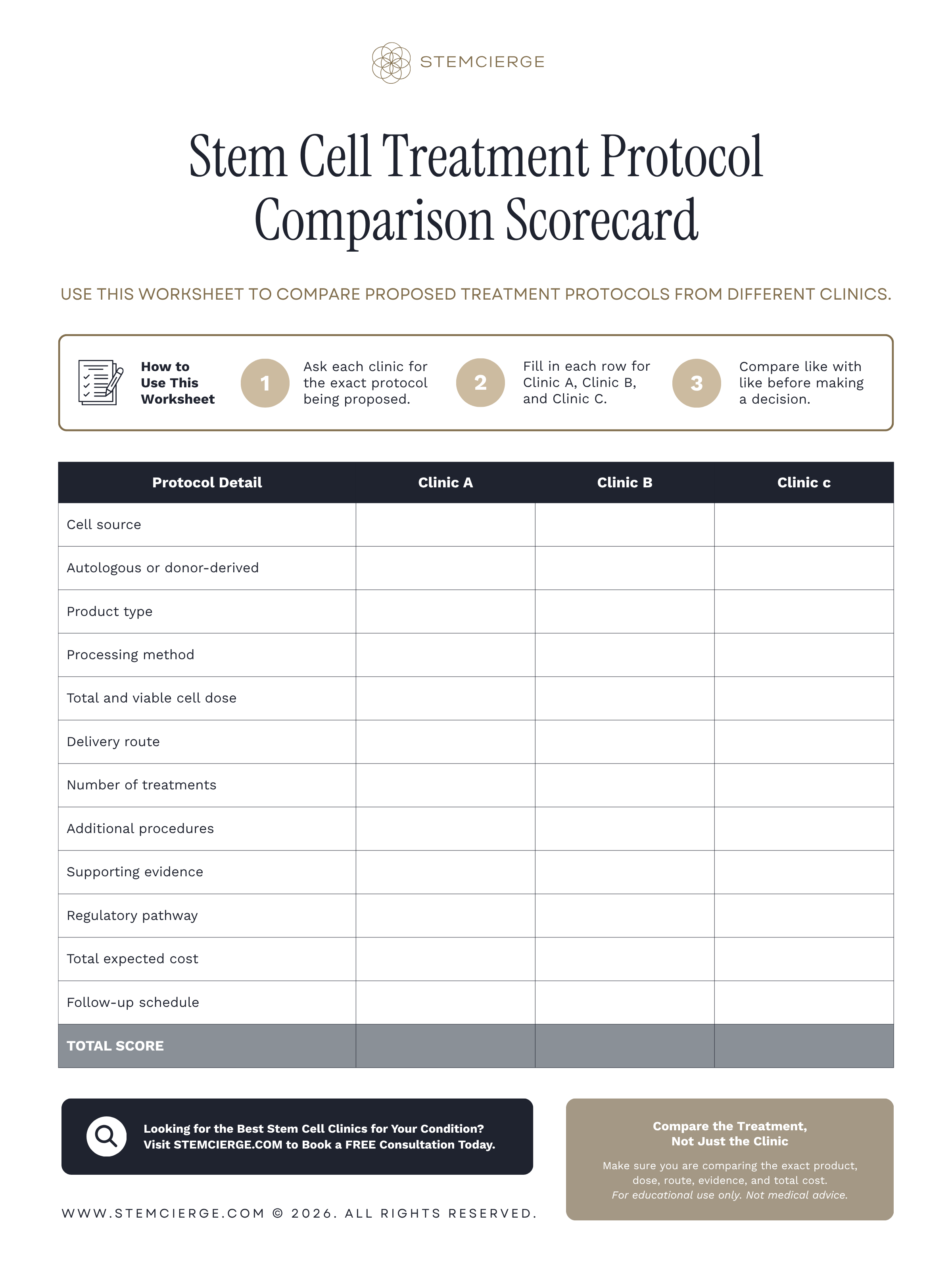
The scorecard should be completed for the specific protocol being offered to you.
Do not compare one clinic’s bone-marrow procedure with another clinic’s culture-expanded umbilical-cord product as if they were equivalent.
The protocol sheet above makes it easier to compare like with like and gives an independent physician enough detail to identify important differences.
Before transferring money, you should be able to answer the following:
The ISSCR recommends consulting a trusted, qualified physician when evaluating investigational or unproven cell-based treatment and receiving clear informed-consent information about risks, alternatives and responsibilities.²
The goal is not to identify the clinic with the most impressive presentation, largest advertised dose or most attractive package.
It is to determine which provider offers the clearest and most verifiable answers about:
A structured comparison cannot eliminate uncertainty. It can, however, prevent clinically important questions from being overshadowed by marketing, testimonials, urgency or price.
The strongest provider is not necessarily the clinic that promises the most.
It is usually the clinic that documents the most, explains uncertainty honestly and gives you enough information to obtain an independent medical opinion before making a commitment.
STEMCIERGE helps patients organize clinic information, identify missing documentation and compare proposed regenerative-medicine protocols more systematically.
STEMCIERGE does not diagnose medical conditions, prescribe treatment or guarantee clinical outcomes. Final treatment decisions should be made with qualified, independent medical professionals.
[Take the free stem cell therapy assessment]
No. The score measures transparency and due-diligence quality, not clinical effectiveness.
A clinic may be highly transparent about an investigational treatment for which efficacy remains uncertain. A high score means you have better information with which to make a decision.
No. Hospital accreditation may provide useful information about the institution’s general systems and standards, but it does not automatically validate every cell product or treatment offered within it.
The specific protocol still requires separate evaluation.
No. Registration does not mean that the treatment has been approved, cleared or endorsed by a regulator or by the registry.²
Verify regulatory and ethics approvals separately.
No. Price should be scored according to transparency, not whether it is high or low.
An affordable clinic can receive 2 points when it provides a complete, itemized quotation. An expensive clinic can receive 0 points when substantial costs are hidden.
Price should only influence the final decision after essential safety and evidence standards have been addressed.
Not necessarily.
A larger number may be irrelevant when the product’s identity, viability, purity, manufacturing quality, route or condition-specific evidence is unclear. Optimal dosing remains uncertain for many investigational cell-based applications.²
Country-level regulation is important, but it is not enough to evaluate a clinic.
Providers within the same country can differ substantially in authorization, physician oversight, product quality, evidence, emergency planning and follow-up care. Evaluate the exact clinic and exact protocol.
No. The scorecard organizes information. It cannot determine whether the proposed treatment is appropriate for your diagnosis, disease severity, medical history or current medications.


-min.png)