🛡️ Thailand Stem Cell Therapy Safety
Stem cell therapy in Thailand can be provided within reputable medical and regulatory settings, but there is no universal answer that applies to every clinic or treatment.
The term “stem cell therapy” covers many different interventions. A joint injection using a defined cellular product has a very different risk profile from an intravenous infusion, an investigational neurological treatment or an invasive spinal procedure.
Safety therefore needs to be evaluated at several levels:
- The patient: Is the treatment medically appropriate for the diagnosis, medical history and current health?
- The physician: Does the doctor have the relevant specialty and procedural experience?
- The cell product: What cells are being used, where do they come from and how were they manufactured?
- The laboratory: What quality-control, sterility and batch-release standards are followed?
- The procedure: Is the proposed dose and route of administration medically justified?
- The regulatory pathway: Is the treatment recognized care, authorized research, a registered product or another legally defined pathway?
- The follow-up plan: Who manages complications or delayed adverse events after treatment?
A modern facility, hospital affiliation or statement that treatment is “Thai FDA approved” should not be treated as sufficient proof of safety on its own.
The more useful question is:
Can the clinic demonstrate that this specific treatment, cellular product and protocol are appropriate, properly manufactured, legally provided and medically supervised for this particular patient?
⚖️ Understanding Thailand’s Stem Cell Laws and Thai FDA Requirements
Stem cell therapy is legal in Thailand, but not every stem cell treatment is automatically authorized, clinically established or appropriate for commercial use.
The legal position depends on several factors:
- The type and source of the cells
- How extensively the cells are processed or expanded
- Whether the treatment is recognized medical practice or clinical research
- Whether the cells qualify as an Advanced Therapy Medicinal Product
- Whether a defined product requires Thai FDA registration
- The condition being treated
- The physician, facility and manufacturing site involved
Thailand does not regulate every cell-based intervention in exactly the same way.
Instead, oversight is divided between product regulation, healthcare-facility standards, physician conduct and human-research requirements.
This distinction is important. A treatment can be legally delivered within an authorized research protocol without being an approved commercial therapy.
A hospital can also be licensed without every stem cell product offered inside that hospital having Thai FDA authorization.
The most accurate conclusion is therefore:
Stem cell therapy can be legally accessed in Thailand, but patients must verify the exact regulatory and clinical pathway applying to the proposed treatment.
🇹🇭 Why Thailand Deserves Serious Consideration for Stem Cell Therapy
Thailand’s appeal extends beyond lower treatment costs or luxury medical tourism.
The country has spent years developing itself as an international medical hub, supported by private hospitals, university medical centres, specialist physicians and healthcare systems accustomed to treating patients from abroad.
Thailand’s Medical Hub strategy includes medical services, academic development, healthcare products and advanced therapeutic innovation.¹ (Thai Med Hub)
Regenerative medicine is increasingly becoming part of that broader strategy.
In 2026, Thailand accelerated the development of Advanced Therapy Medicinal Products (ATMPs) through regulatory support, clinical-research networks, manufacturing infrastructure and collaboration between government agencies, universities and private companies.
The Ministry of Public Health has also supported the creation of a national ATMP policy structure and an Advanced Therapy training and development initiative.² (FDA Thailand)
The Thai FDA describes its ATMP framework as an end-to-end system covering:
- Development before human use
- Clinical research
- Manufacturing-site controls
- Good Manufacturing Practice
- Transportation and product handling
- Commercial product registration
- Ongoing safety and effectiveness requirements
This is a meaningful development for patients.
It shows that Thailand is not treating stem cell medicine as an informal wellness service.
It is building a more structured pathway for complex cell, gene and tissue-based therapies.³ (FDA Thailand)
Thailand is also strengthening international regulatory cooperation.
In July 2026, the Thai FDA and Japan’s Pharmaceuticals and Medical Devices Agency discussed ATMP oversight, clinical research and regulatory harmonization across Asia.⁴ (FDA Thailand)
None of these developments proves that every Thai clinic offers a high-quality treatment.
However, they support a more positive and accurate conclusion:
Thailand has a developing advanced-therapy ecosystem with genuine regulatory, academic and manufacturing capabilities.
The patient’s task is to identify the providers operating at the highest level within that ecosystem.
For a broader overview of treatment options, read our FULL guide to stem cell therapy in Thailand.
🔗 Read more → Stem Cell Therapy in Thailand: 2026 Complete Guide (Costs, Clinics & Safety)
☑️ Is Stem Cell Therapy Legal in Thailand?
Yes, stem cell therapy is legal in Thailand when it is provided through an applicable medical, research or product-authorization pathway.
The difficulty is that the term stem cell therapy covers many different interventions.
A hematopoietic stem cell transplant for a defined blood disorder is not regulated in the same way as:
- Culture-expanded mesenchymal stromal cells
- Donor-derived umbilical-cord cells
- Autologous adipose-derived preparations
- Corneal epithelial stem cell transplantation
- CAR-T or other genetically modified cell products
- Experimental intravenous cell infusions
- A patient-specific preparation produced by a hospital laboratory
The exact classification affects which approvals, standards and documents should exist.
These categories can overlap in complex cases, but they should not be treated as interchangeable.
A treatment provided under research approval is not necessarily unlawful or illegitimate.
However, the patient should be clearly informed that it is investigational, what uncertainties remain and which ethics and regulatory bodies approved the study.
Similarly, a patient-specific manufacturing pathway does not automatically prove that the treatment is clinically established or effective for the condition being treated.
🏛️ Who Regulates Stem Cell Therapy in Thailand?
Thailand’s system is best understood as several layers of oversight rather than one regulator controlling every aspect of care:
- Thai FDA
- Department of Health Service Support
- Medical Council of Thailand
- Research Ethics Committees
💊 The Thai Food and Drug Administration
The Thai FDA regulates medicinal products, including cell-based treatments that meet the definition of an Advanced Therapy Medicinal Product.
Its responsibilities can include:
- Product classification
- Clinical-research authorization
- Manufacturing-site licensing
- GMP or GMDP compliance
- Product registration
- Importation controls
- Safety surveillance
- Commercial market authorization
The Thai FDA maintains a dedicated ATMP portal containing classification guidance, cell-therapy registration guidance, gene-therapy guidance, conditional approval information and records of authorized ATMP research.⁵ (FDA Thailand)
🏥 The Department of Health Service Support
The Department of Health Service Support oversees hospitals and clinics as healthcare facilities.
Thailand’s medical-cell service standards address issues such as:
- Qualified personnel
- Appropriate treatment facilities
- Infection-control systems
- Laboratory arrangements
- Patient consent
- Medical records
- Referral procedures
- Management of complications
This means a cell-based procedure that is not regulated as a conventional commercial drug is not necessarily outside all oversight.
The facility and the clinical service may still be subject to healthcare-service rules.⁶ (ศูนย์สนับสนุนบริการสุขภาพที่ 1)
👨⚕️ The Medical Council of Thailand
The Medical Council regulates physician licensing, professional ethics, standards of practice and the boundary between accepted treatment and human research.
Its published rules and announcements include standards covering:
- Stem cell transplantation
- Human research
- Donor hematopoietic stem cell transplantation
- Corneal and ocular-surface cell therapy
- Cell therapy for hematologic diseases and hematologic cancers
The Medical Council has long required stem cell uses outside recognized professional standards to be handled through an appropriate research and ethics framework.⁷ (The Medical Council of Thailand)
🧪 Research Ethics Committees
When a treatment is offered as clinical research, institutional ethics review becomes a critical part of the pathway.
Ethics approval does not prove that a therapy works.
It indicates that a defined study protocol, consent process and patient-protection framework have been reviewed.
Patients should therefore ask for:
- The complete study title
- The protocol number
- The ethics committee
- The principal investigator
- The study sponsor
- The Thai FDA authorization, where applicable
- A written explanation of whether the patient is paying to participate
🧬 What Is an Advanced Therapy Medicinal Product?
Advanced Therapy Medicinal Products are complex biological treatments based on cells, genes or engineered tissues.
The Thai FDA identifies four broad ATMP categories.³ (FDA Thailand)
This classification matters because living cells are more difficult to standardize than conventional medicines.
A tablet can often be tested as a stable finished product.
A cell therapy may be affected by:
- Donor characteristics
- Tissue source
- Culture conditions
- Number of expansion cycles
- Cryopreservation
- Transportation time
- Temperature control
- Thawing procedures
- Cell viability at administration
- Differences between manufacturing batches
For this reason, ATMP regulation extends beyond the syringe given to the patient.
The laboratory, manufacturing process, documentation and chain of handling can all be part of the product’s quality profile.
🔬 When Does Thai FDA Approval Apply?
Thai FDA involvement depends on how the treatment is classified.
Products containing cultured, expanded or otherwise substantially processed cells are more likely to fall within the ATMP and medicinal-product framework than cells that undergo limited handling within a medical procedure.
The Thai Department of Medical Sciences specifically described cultured mesenchymal stromal cells and related cell-culture products as ATMPs subject to drug regulation and quality requirements.
Its December 2024 guidance emphasized registration, PIC/S GMP, controlled cleanrooms, production records and quality testing.⁸ (DMSC)
Important classification factors can include:
- Whether the cells are autologous or donor-derived
- Whether they have been cultured or expanded
- Whether their biological characteristics have been modified
- Whether they are being used for their original biological function
- Whether genetic modification is involved
- Whether the preparation is patient-specific
- Whether the product is intended for commercial distribution
- Whether it is being used in clinical research
Patients should not attempt to determine the legal classification based on marketing language alone.
Instead, ask the clinic:
"What is the formal regulatory classification of the exact product being proposed, and can you provide the supporting authorization or legal pathway in writing?"
🩺 Which Stem Cell Treatments Are Recognized in Thailand?
Thailand has established professional standards in specific areas of cell therapy.
The clearest examples include hematopoietic stem cell transplantation for appropriate hematologic conditions.
The Medical Council also publishes standards relating to corneal and ocular-surface stem cell procedures, as well as updated standards for cell therapy in hematologic diseases and hematologic cancers.⁷ (The Medical Council of Thailand)
These examples reveal an important principle:
Legitimate stem cell medicine is usually indication-specific, specialist-led and supported by defined clinical standards.
Patients should be more cautious when a single clinic promotes the same cell product for a wide range of unrelated conditions, such as:
- Osteoarthritis
- Parkinson’s disease
- Autism
- Spinal cord injury
- Autoimmune disease
- Infertility
- Erectile dysfunction
- General anti-aging
- Fatigue
- Cognitive optimization
A broad treatment menu does not necessarily prove wrongdoing, but it increases the importance of verifying the evidence and regulatory basis for each indication.
The types of stem cells used in Thailand can also differ substantially in source, processing and intended clinical function.
🔗 Read more → What Type of Stem Cells Are Used in Thailand? UC-MSCs vs Autologous Cells vs Exosomes
🧫 Does Experimental Stem Cell Therapy Mean Illegal?
No. An experimental treatment may be legally studied under an authorized clinical-research protocol.
That does not mean it is approved as routine care, but it may still represent legitimate scientific and medical work.
Thailand’s ATMP portal publicly distinguishes between registration guidance, approved products and authorized ATMP research.
The portal lists several research projects and provides specific standards for clinical drug research.⁵ (FDA Thailand)
A properly conducted clinical study should generally include:
- A defined protocol
- Research ethics approval
- Regulatory authorization where required
- Eligibility criteria
- Informed consent
- Adverse-event monitoring
- Data collection
- Follow-up requirements
- Clear disclosure of experimental status
The problem arises when an investigational intervention is marketed as though it were an established, proven treatment.
A clinic should not blur the difference between:
- Approved treatment
- Recognized professional practice
- Authorized clinical research
- Compassionate or patient-specific use
- An unverified commercial intervention
Patients considering research participation should ask who is responsible for their care if complications occur and whether long-term follow-up continues after they return home.
🏭 Thailand’s Growing ATMP Manufacturing Infrastructure
One of the most positive developments in Thailand is the movement from broad policy toward inspected, operational infrastructure.
In February 2026, Chulalongkorn University’s EC-ATMP centre reported receiving Thailand’s first GMDP PIC/S certification for investigational cell-therapy products.⁹ (Chulalongkorn Med School)
The Thai FDA has also reported that:
- University hospitals are developing ATMP research pipelines
- Private manufacturers are upgrading toward GMP standards
- A Thai-developed commercial ATMP was progressing through clinical development
- The regulator is offering earlier consultation to developers
- Thailand is building a coordinated ATMP ecosystem rather than relying only on imported technology³ (FDA Thailand)
In May 2026, the Ministry of Public Health announced further national coordination around ATMP research, infrastructure, manufacturing and patient access.
The Thai FDA also highlighted an ATMP One Stop Service and fast-track mechanisms intended to support responsible development while maintaining safety and efficacy requirements.² (FDA Thailand)
These developments do not validate every commercial stem cell clinic.
They do, however, strengthen Thailand’s position as a country capable of developing regulated advanced therapies, not merely selling medical-tourism packages.
🧼 What Does GMP Mean for Stem Cell Therapy?
GMP stands for Good Manufacturing Practice. GMDP adds controls related to manufacturing and distribution.
For cell therapy, these systems may cover:
- Facility design
- Cleanroom conditions
- Air quality
- Environmental monitoring
- Staff training
- Aseptic processing
- Equipment qualification
- Raw materials
- Donor traceability
- Production records
- Product release
- Storage
- Transportation
- Deviation reporting
GMP is highly important because living cell products cannot simply be sterilized after production without damaging or destroying the cells.
However, GMP should be interpreted correctly.
The practical lesson is simple:
GMP is a manufacturing-quality standard, not a guarantee of clinical success.
A clinic should be able to explain the exact scope of the certification.
A laboratory may be certified for certain activities without that certification covering every product or protocol promoted by the clinic.
🧪 Which Batch Tests Matter?
A credible provider should be able to explain how the cells were tested before release.
Thailand’s Department of Medical Sciences has emphasized sterility, purity, identity, potency and viability as important quality considerations for cultured mesenchymal stromal cells.⁸ (DMSC)
Patients should ask whether the results apply to the specific batch they will receive.
A generic laboratory brochure is not the same as a patient-specific or lot-specific Certificate of Analysis.
Cell count alone is also insufficient. A larger number does not prove:
- Cell identity
- Purity
- Viability
- Sterility
- Potency
- Suitability for the condition
- Appropriate dose-response
- Better clinical outcomes
For a deeper clinic-evaluation framework, use the international stem cell treatment comparison scorecard.
⚠️ What Are the Risks of Stem Cell Therapy in Thailand?
Stem cell therapy is sometimes marketed as minimally invasive or “natural,” but cellular treatments are not risk-free.
The potential risks vary considerably depending on the cellular product, manufacturing process, patient, condition and route of administration.
Product contamination or infection
Living cell products require controlled collection, manufacturing, storage and administration. Inadequate processing or handling may introduce contamination risks.
This is one reason sterility, endotoxin, mycoplasma and other batch-release testing matter.
Infusion or treatment reactions
Intravenous or locally administered cellular products may produce adverse reactions. The clinic should explain what monitoring takes place during and after treatment and how unexpected reactions are managed.
Procedure-related complications
Some risks come from the delivery procedure rather than the cells themselves.
Joint injections, image-guided procedures, epidural administration and other invasive techniques can have different procedural risks and should be performed by appropriately qualified physicians.
Inappropriate patient selection
A cellular therapy that may be reasonable for one patient may be inappropriate for another.
Medical history, diagnosis, imaging, medications, comorbidities and previous treatments should be reviewed before a treatment protocol is recommended.
Poorly characterized cell products
Patients should be cautious when a provider cannot clearly identify the cell source, manufacturing laboratory, viability, quality-control testing, dose or route of administration.
A large advertised cell count does not by itself demonstrate that a treatment is safer or more effective.
Limited evidence for the proposed indication
Regulatory compliance and clinical effectiveness are not the same thing.
A treatment may be legally provided or studied without strong evidence that it will improve a particular condition. Patients should understand how closely the scientific evidence matches the exact cell product, dose, delivery route and diagnosis being proposed.
Delaying established medical care
Another potential risk is delaying a conventional treatment with stronger supporting evidence while pursuing an experimental regenerative intervention.
For this reason, stem cell therapy should be considered within the patient’s broader clinical strategy rather than automatically treated as a replacement for established medical care.
🏷️ What Does “Thai FDA Approved” Actually Mean?
“Thai FDA approved” is one of the most powerful phrases used in clinic marketing.
It is also one of the most easily misunderstood.
The phrase should always be followed by a more precise question:
What exactly has been approved?
A responsible clinic should be willing to provide:
- The exact product name
- The authorization or registration number
- The registered indication
- The manufacturer
- The manufacturing site
- The scope of GMP or GMDP certification
- The study number if investigational
- The legal basis if patient-specific
The Thai FDA provides tools for checking product authorization, manufacturing licences and GMDP status.
The Medical Council also maintains a physician-verification database in Thai and English.¹⁰ (FDA Thailand)
🔎 How to Verify the Safety of a Stem Cell Clinic in Thailand
Patients should evaluate the proposed treatment in a logical order.
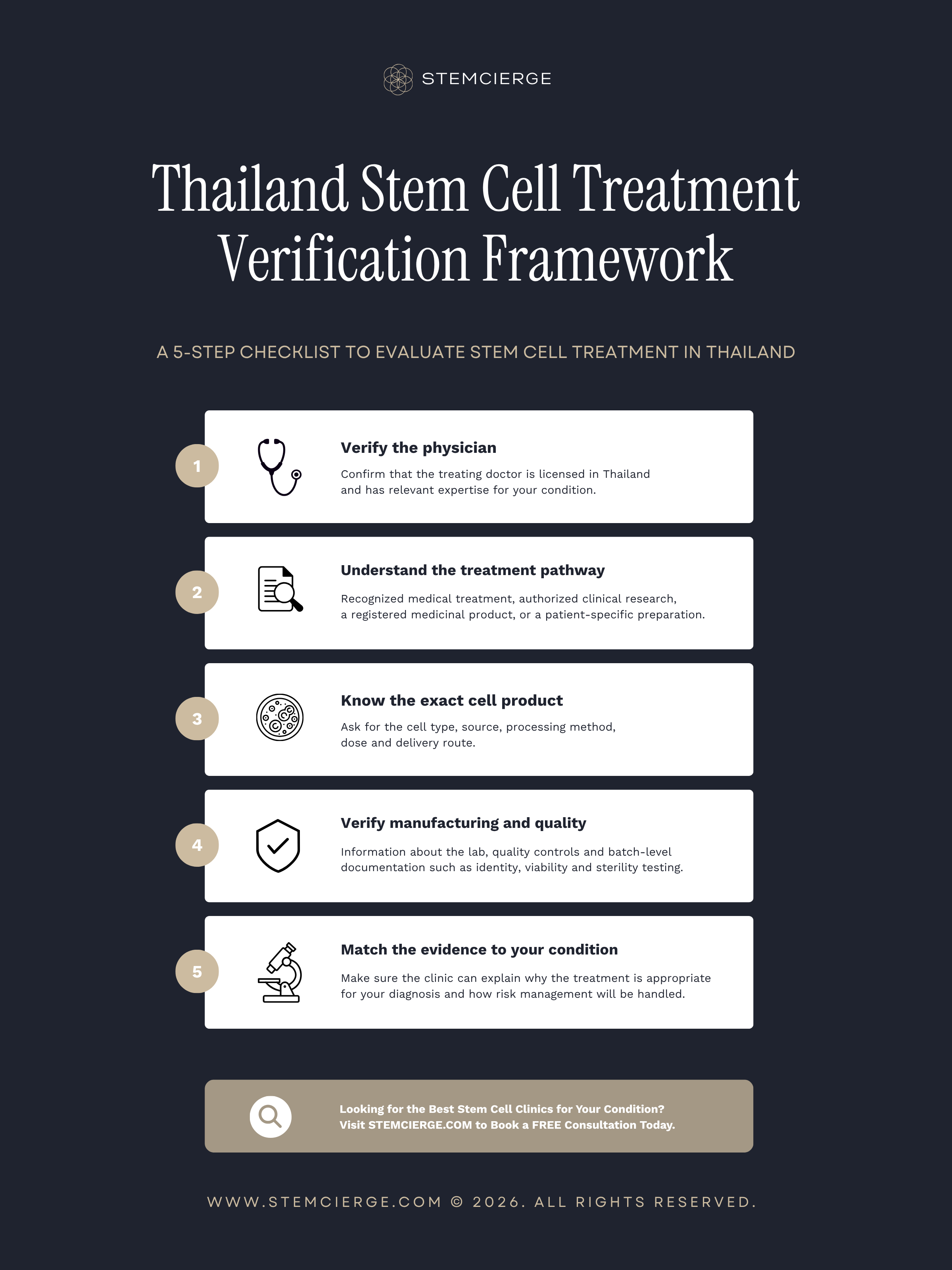
1. Verify the treating physician
Confirm:
- Full name
- Thai medical licence
- Specialty
- Relevant training
- Experience treating your condition
- Who will perform the procedure
- Who will manage complications
A medical licence is the starting point, not the final proof of suitability.
2. Identify the exact cell product
Ask:
- What type of cells are being used?
- Where do they come from?
- Are they autologous or donor-derived?
- Are they cultured or expanded?
- How many passages are used?
- Are they fresh or cryopreserved?
- What is the total dose?
- What is the viable dose at administration?
Vague descriptions such as “premium stem cells” or “high-potency young cells” are not scientifically adequate.
3. Establish the regulatory pathway
The clinic should explain whether the intervention is:
- Recognized medical treatment
- An authorized clinical study
- A registered medicinal product
- A patient-specific preparation
- Another legally defined pathway
Request the explanation in writing.
4. Verify the laboratory
Determine:
- The laboratory’s legal name
- Where it is located
- Whether it is independent from the clinic
- What licence it holds
- The scope of its GMP or GMDP certification
- Whether the certification covers the proposed cell product
- How cells are transported to the patient
5. Request batch-level documentation
Ask for a sample Certificate of Analysis before paying a deposit and the final batch-specific report before treatment.
At a minimum, clarify:
- Identity
- Viability
- Sterility
- Endotoxin
- Mycoplasma
- Donor screening
- Product-release criteria
6. Match the evidence to the protocol
The scientific evidence should match:
- Your diagnosis
- The cell source
- The product type
- The dose
- The delivery route
- The treatment schedule
- The patient population
A paper about bone-marrow cells injected into knees does not automatically support umbilical-cord cells administered intravenously for the same condition.
7. Review the emergency plan
Confirm:
- Where emergencies will be treated
- The nearest appropriate hospital
- Transfer arrangements
- Who pays for emergency treatment
- Who manages delayed complications
- How your home physician will receive your records
The emergency plan should be specific, not simply “we have a doctor available.”
For a complete due-diligence checklist, read 7 questions to ask before choosing a stem cell clinic abroad.
🔗 Read more → 7 Essential Questions to Ask Before Choosing a Stem Cell Clinic Abroad
⭐ What a High-Quality Thai Provider Should Look Like
The strongest providers in Thailand should not depend on broad claims about the country, the hospital or the number of cells administered.
They should demonstrate quality at the level of the individual patient and protocol.
A credible provider should:
- Review medical records before recommending treatment
- Involve a physician with relevant expertise
- Explain whether the treatment is established or investigational
- Identify the cell source and manufacturer
- Provide a rational clinical basis for the protocol
- Discuss meaningful risks and alternatives
- Explain uncertainty without becoming defensive
- Provide laboratory and batch documentation
- Use clear informed consent
- Maintain an emergency and referral pathway
- Offer structured follow-up after the patient returns home
- Avoid guaranteed results
This is where Thailand can compare favourably with other destinations.
Thailand has the medical institutions, academic centres, hospitality infrastructure and growing advanced-therapy capabilities needed to deliver sophisticated international care.
The deciding factor is whether the individual provider connects those strengths into a transparent, medically justified protocol.
🚩 Stem Cell Therapy Safety Red Flags in Thailand
These red flags are not unique to Thailand.
They should be applied when evaluating stem cell treatment in every destination.
Proceed cautiously when a clinic:
- Guarantees a cure or specific level of improvement
- Claims the treatment has no meaningful risks
- Uses one product for many unrelated conditions
- Refuses to name the laboratory
- Will not explain the regulatory pathway
- Treats GMP as proof of clinical effectiveness
- Relies mainly on testimonials
- Focuses on cell count without discussing viability or identity
- Pressures the patient to pay before medical-record review
- Discourages a second medical opinion
- Cannot provide a written emergency plan
- Refuses to release treatment records or batch documentation
- Calls a treatment “Thai FDA approved” without an authorization number
A red flag does not always prove that a clinic is operating illegally.
It does indicate that the patient lacks information needed to make an informed decision.
🚀 What Changed in Thailand in 2026?
The direction of travel is increasingly positive.
🏛️ ATMPs received greater national coordination
In May 2026, Thailand announced stronger national-level coordination around advanced therapies, including research, development, infrastructure, manufacturing and access.² (FDA Thailand)
⚡ The Thai FDA expanded development support
The regulator described an ATMP One Stop Service, fast-track support and earlier engagement with developers, while continuing to emphasize safety, efficacy and international standards.² (FDA Thailand)
🏭 Manufacturing capability became more visible
Thailand’s first reported GMDP PIC/S certification for investigational cell-therapy products demonstrated that the country is translating regulatory standards into inspected infrastructure.⁹ (Chulalongkorn Med School)
🎓 Advanced-therapy education gained policy support
Thailand’s Medical Hub leadership supported the development of a School of Advanced Therapy and closer collaboration between the Ministry of Public Health, hospitals and medical schools.¹¹ (Thai Med Hub)
🌏 International regulatory cooperation expanded
The Thai FDA’s July 2026 discussions with Japan’s PMDA focused on ATMPs, clinical research and broader regulatory harmonization in Asia.⁴ (FDA Thailand)
These changes do not mean that all marketed treatments are now approved.
They indicate that Thailand is actively strengthening the systems needed to research, manufacture, assess and eventually commercialize advanced therapies.
🌴 Is Thailand a Good Destination for Stem Cell Therapy?
Thailand can be a compelling destination for carefully selected patients.
Its advantages include:
- An established international healthcare environment
- Experienced private hospitals and academic medical centres
- Increasing investment in advanced therapies
- A dedicated Thai FDA ATMP framework
- Growing cell-therapy manufacturing capability
- Specialist medical and rehabilitation services
- International-patient coordination
- A treatment and recovery environment that many patients find attractive
Thailand should therefore not be viewed merely as a low-cost medical-tourism destination.
Its stronger long-term positioning is as an internationally connected healthcare market developing increasingly sophisticated capabilities in regenerative medicine, biotechnology and advanced therapies.
However, country-level strengths do not eliminate provider-level variation.
The best decision is not:
“Thailand is good, so every Thai clinic must be good.”
It is:
“Thailand offers a credible and increasingly advanced environment.
I now need to identify the physician, provider and protocol that meet the highest standards within that environment.”
Patients comparing destinations may also find our guide to the best countries for stem cell therapy useful.
🔗 Read more → Best Destinations for Stem Cell Therapy in 2026: Cost, Treatments & Safety Compared
🧭 Final Perspective: Thailand Is Becoming More Than a Medical-Tourism Destination
Thailand’s stem cell sector should neither be promoted uncritically nor dismissed as an unregulated market.
The more accurate picture is considerably more promising.
Thailand has:
- A dedicated ATMP regulatory framework
- Professional standards for defined cell-therapy applications
- Human-research requirements
- Hospital medical-cell service standards
- Emerging GMDP manufacturing infrastructure
- University-led clinical development
- National ATMP policy support
- Growing international regulatory cooperation
These developments position Thailand as one of the more interesting regenerative medicine markets in Asia.
The opportunity for patients is real, but it is provider-specific.
A transparent clinic should be able to show how the proposed treatment is medically justified, legally provided, manufactured, tested and monitored.
When those elements are present, Thailand can offer more than affordability or hospitality.
It can provide access to an increasingly advanced and internationally connected healthcare ecosystem.
For patients prepared to perform the right due diligence, Thailand deserves serious consideration as a stem cell therapy destination in 2026.
🧭 Take the Next Step With Greater Clarity
Choosing a stem cell clinic should involve more than comparing prices, cell counts or marketing claims.
You need to understand the treatment pathway, product quality, physician oversight, regulatory status and whether the proposed protocol is appropriate for your situation.
Complete the FREE 3-minute STEMCIERGE Assessment to receive a more structured view of your international treatment options and prepare for more informed conversations with clinics and physicians.
❓ Frequently Asked Questions
Is stem cell therapy safe in Thailand?
Stem cell therapy in Thailand can be provided within reputable medical and regulatory settings, but safety depends on the specific clinic, physician, cellular product, procedure and patient.
Patients should verify how the cells are sourced and manufactured, what quality-control testing is performed, who administers the treatment, which regulatory pathway applies and how complications are managed.
A clinic being located in Thailand, operating inside a hospital or using a GMP-certified laboratory does not by itself prove that every treatment it offers is safe or clinically appropriate.
What are the main risks of stem cell therapy in Thailand?
Potential risks can include contamination or infection, treatment reactions, procedure-related complications, poorly characterized cellular products and inappropriate patient selection.
The risk profile also depends heavily on the route of administration. A joint injection, intravenous infusion and invasive spinal procedure should not be treated as equivalent interventions.
Patients should also consider the risk of spending substantial money on a treatment with limited evidence for their condition or delaying established medical care.
How can I tell if a stem cell clinic in Thailand is safe and legitimate?
Verify the clinic, treating physician and cellular product separately.
Ask for the physician’s credentials, exact cell source, manufacturing laboratory, relevant batch-testing documentation, regulatory pathway and evidence supporting the proposed treatment.
A credible provider should also explain meaningful risks, treatment limitations, alternative options and what happens if complications occur.
Is stem cell therapy legal in Thailand?
Yes. Stem cell therapy can legally be provided in Thailand through recognized medical practice, clinical research, registered medicinal products or other applicable pathways. The exact requirements depend on the cells, processing method, indication and intended use.
Is every stem cell treatment in Thailand approved by the Thai FDA?
No. A clinic licence, hospital accreditation or GMP laboratory does not automatically mean that every treatment offered has Thai FDA product authorization.
Patients should verify the exact product and indication.
Are mesenchymal stem cells approved in Thailand?
The answer depends on the precise product and pathway.
In December 2024, the Department of Medical Sciences stated that no MSC product was registered with the Thai FDA at that time and that most MSC use occurred through patient-specific or research contexts.
Because authorization status can change, patients should verify the current product record directly rather than relying on a historical statement or clinic marketing.⁸
Can MSC therapy still be legally studied?
Yes. Investigational MSC products may be studied under an appropriately authorized clinical-research protocol with the required ethics, regulatory and clinical safeguards.
Does GMP certification prove a treatment is effective?
No. GMP helps establish manufacturing control and consistency. It does not prove that the treatment works for a specific condition.
How can I verify a doctor in Thailand?
The Medical Council of Thailand provides an online physician-verification system in Thai and English. Patients can search by name, surname or medical-licence number.¹⁰
What documents should a Thai stem cell clinic provide?
Depending on the pathway, useful documents may include:
- Physician credentials
- Facility licence
- Product registration or research authorization
- Ethics approval
- Laboratory licence
- GMP or GMDP certificate
- Certificate of Analysis
- Donor-screening information
- Informed-consent form
- Treatment protocol
- Emergency-transfer plan
- Follow-up schedule
Is a clinical-trial registration enough?
No. A registry entry does not by itself prove regulatory authorization, ethics approval, safety or effectiveness. Request the full study and approval details.
Should I pay before a physician reviews my records?
A limited administrative or consultation fee may be reasonable, but patients should be cautious when asked for a large non-refundable treatment deposit before an appropriately qualified physician has reviewed their medical history and confirmed potential suitability.
Is Thailand better than other stem cell destinations?
No country is universally best for every patient or condition.
Thailand may be particularly attractive to patients seeking established international healthcare infrastructure, specialist medical services and access to a rapidly developing advanced-therapy environment.
The final decision should still be based on the exact provider and protocol
⚠️ Medical Disclaimer
This article is provided for educational purposes only. It does not constitute medical or legal advice, confirm the status of any individual clinic or product, or recommend a particular treatment.
Regulations and authorization records may change. Patients should verify current information with the relevant Thai authorities and consult qualified physicians before making treatment decisions.
📚 References
- Thailand Department of Health Service Support. Medical Hub strategy and international healthcare policy. (Thai Med Hub)
- Thai Food and Drug Administration. National coordination, One Stop Service and fast-track development for ATMPs, May 2026. (FDA Thailand)
- Thai Food and Drug Administration. Road to ATMPs: Thai FDA Affirms Thailand Will Not Be Left Behind, March 2026. (FDA Thailand)
- Thai Food and Drug Administration. Thailand–Japan regulatory cooperation involving ATMPs and clinical research, July 2026. (FDA Thailand)
- Thai FDA Medicines Regulation Division. Advanced Therapy Medicinal Products portal and regulatory guidance. (FDA Thailand)
- Ministry of Public Health and Department of Health Service Support. Medical-cell service standards for healthcare facilities, 2022. (ศูนย์สนับสนุนบริการสุขภาพที่ 1)
- Medical Council of Thailand. Stem cell ethics rules and professional standards for hematopoietic, corneal and hematologic cell therapies. (The Medical Council of Thailand)
- Department of Medical Sciences. Manufacturing and quality control of mesenchymal stromal cells and related products, December 2024. (DMSC)
- Faculty of Medicine, Chulalongkorn University. First reported Thai GMDP PIC/S certification for investigational cell-therapy products, February 2026. (Chulalongkorn Med School)
- Medical Council of Thailand. Physician licence-verification database. (CheckMD)
- Thailand Medical Hub. Policy support for the School of Advanced Therapy and coordinated ATMP development, March 2026. (Thai Med Hub)