🇹🇭 Thailand Stem Cell Therapy Guide: Key Takeaways
- Stem cell therapy in Thailand is not covered by one blanket approval. The regulatory status depends on the exact cell product, treatment, clinic, and medical indication.
- Many commercial MSC-based treatments are still investigational, especially for longevity, neurological conditions, autoimmune disease, and broad systemic wellness claims.
- Knee osteoarthritis is one of the better-studied regenerative applications, but results vary and current evidence does not support guaranteed cartilage regeneration.
- A higher stem cell count does not automatically mean a better treatment. Cell source, viability, dose rationale, delivery method, and clinical evidence matter more than headline numbers.
- Clinic licences, GMP certification, and Certificates of Analysis measure different things. None of them, on its own, proves that a treatment is effective for your condition.
- Thailand can offer strong international-patient support and advanced private healthcare infrastructure, but the quality of the individual provider, physician, cell product, and protocol still needs to be verified carefully.
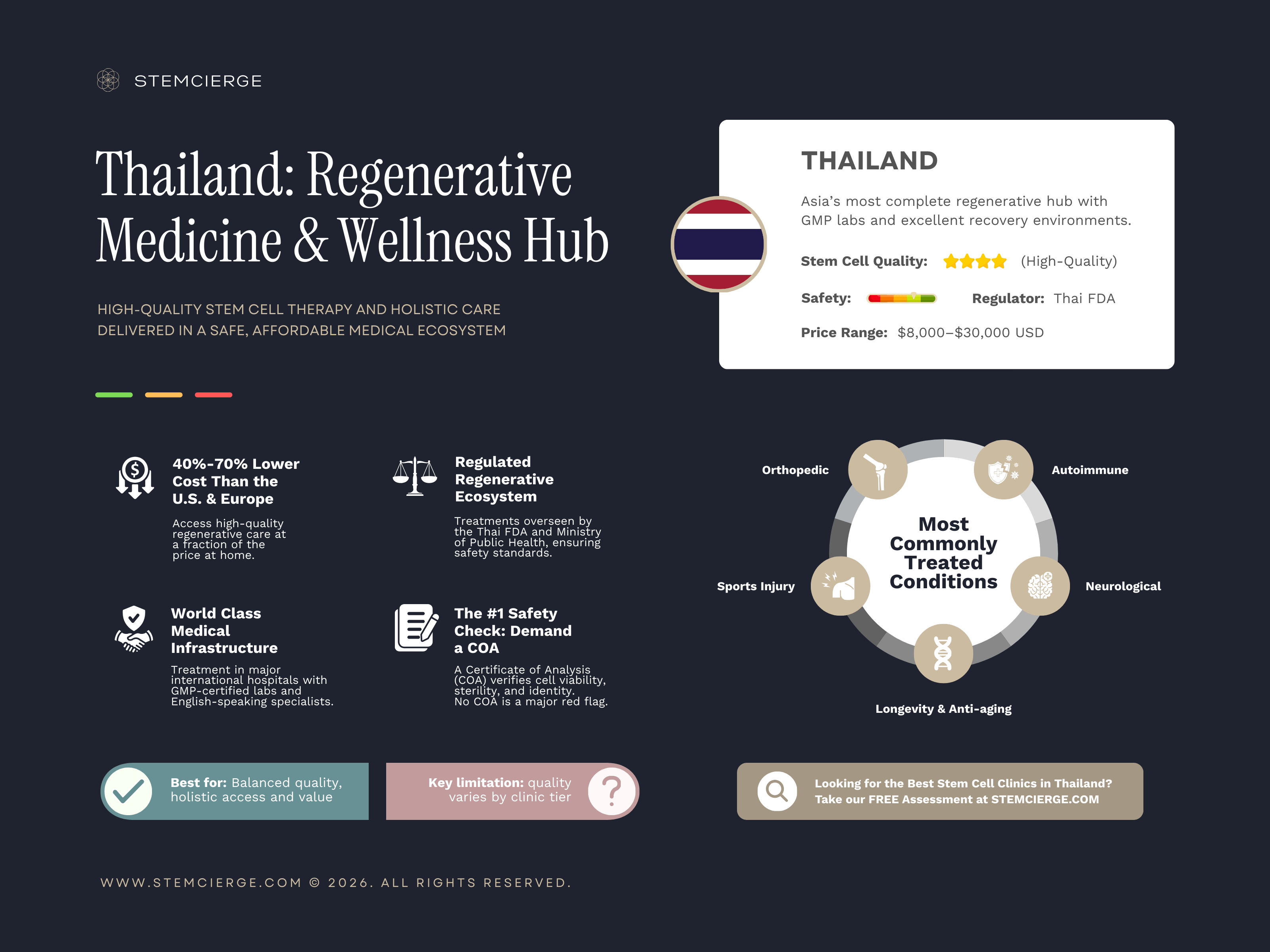
Editorial Note: This guide is designed as a central gateway to the STEMCIERGE Thailand Stem Cell Therapy Resource Center, with each section linking to deeper resources on costs, regulation, clinics, treatments, cities, and patient planning.
🧬 Why Is Thailand Emerging as a Global Regenerative Medicine Hub?
Thailand combines established private hospitals, experienced international-patient services, and a growing regenerative medicine sector.
For international patients, consultations, imaging, laboratory testing, treatment, rehabilitation, and recovery can often be coordinated within one trip. Costs range from about THB ฿80,000 (USD $2,400) for localized procedures to more than THB ฿1.39 million (USD $41,500) for complex multi-day programs.
Thailand is also strengthening its advanced therapy medicinal product (ATMP) framework. In 2026, the Thai FDA outlined a more structured system covering research, manufacturing, clinical use, and commercial registration.²
These developments are expanding Thailand’s regenerative medicine ecosystem, but clinic quality, treatment protocols, and cell products still vary significantly.
🏥 What Factors Should Patients Know About Stem Cells in Thailand?
A 2026 study of international travellers found that Thailand’s healthcare reputation and comparatively lower costs influenced interest in receiving medical care in the country.³
However, its regenerative medicine market includes both well-documented medical programs and interventions supported by much weaker evidence.
⚖️ Is Stem Cell Therapy Legal in Thailand?
Yes, stem cell therapy can be legally provided in Thailand through an applicable medical, research or product-authorization pathway.
However, the term stem cell therapy covers many different interventions, and each may be regulated differently.
The Thai FDA regulates relevant advanced therapy medicinal products, including cell therapies, gene therapies and tissue-engineered products.
Its developing framework covers clinical research, manufacturing, GMP inspection, product registration and commercial authorization.¹
The Medical Council of Thailand also maintains professional and ethical rules relating to stem cell research, transplantation and physician conduct.⁴
What are the main treatment pathways?
In 2026, Thailand continued strengthening its ATMP system and cell-bank standards¹⁴. The Thai FDA reported that one imported ATMP had been registered, while Thai institutions were developing additional products through research and registration pathways.²
What should a clinic be able to show?
Depending on the intervention, ask for:
- The treating physician’s name and licence
- The facility licence
- The exact cell product and manufacturer
- Product registration or research authorization
- Ethics approval, where applicable
- Laboratory and manufacturing documentation
- Batch-specific testing
- Informed-consent documents
- Emergency and hospital-transfer arrangements
🔗 Read the full guide → Thailand Stem Cell Therapy Laws (2026): Safety & Thai FDA Rules Explained
🔬 What Types of Stem Cells Are Used in Thailand?
Thailand’s regenerative medicine market includes several different cell and cell-derived products. They should not be treated as interchangeable.
The most common categories are hematopoietic stem cells, mesenchymal stromal cells from different tissue sources and extracellular vesicle products commonly marketed as exosomes.
Hematopoietic stem cells
Hematopoietic stem cells form blood and immune cells. They are used in established transplant programs for conditions such as certain leukaemias, lymphomas, immune disorders and bone marrow diseases.
These treatments are highly specialized and are performed in hospital transplant units. They are fundamentally different from commercial MSC injections or wellness infusions.
Mesenchymal stromal cells
Products described as mesenchymal stem cells are more accurately called mesenchymal stromal cells, or MSCs.
Clinics may offer MSCs derived from:
- Umbilical cord tissue
- Bone marrow
- Adipose tissue
- Placental or other perinatal tissues
The tissue source alone does not determine quality. Manufacturing method, donor screening, expansion, passage number, storage, viability, identity and batch testing all matter.
International Society for Cell & Gene Therapy criteria describe culture-expanded MSCs as plastic-adherent cells expressing markers such as CD73, CD90 and CD105 while lacking defined hematopoietic markers.
These criteria help establish cell identity, but they do not prove clinical effectiveness.⁵
Autologous cells
Autologous cells are collected from the patient, usually from bone marrow or adipose tissue.
They avoid donor-recipient alloimmune mismatch, but that does NOT automatically make them safer, more potent or more effective.
Their characteristics may be affected by the patient’s age, health, tissue source and processing method.
Donor-derived cells
Allogeneic cells come from a screened donor. Umbilical cord tissue-derived MSCs are frequently promoted by commercial regenerative clinics because they can be expanded and manufactured in batches.
Patients should still verify:
- Donor eligibility and screening
- Tissue source
- Manufacturing facility
- Culture and expansion method
- Passage number
- Storage and transportation
- Batch-release testing
Exosomes and extracellular vesicles
Exosomes are not stem cells. They are small extracellular vesicles involved in cell-to-cell communication.
Commercial exosome products vary widely in source, purification, concentration and characterization.
Current clinical interest is significant, but evidence and regulatory standards remain less mature than marketing often suggests.
Human research is beginning to emerge, particularly in knee osteoarthritis, but remains early and inconsistent.
A 2026 review concluded that current evidence is insufficient to support routine clinical use of extracellular-vesicle therapies for knee OA.
An August 2026 network meta-analysis added encouraging preclinical evidence from rat models, but those findings cannot establish effectiveness in humans.⁷˒⁸
The ISSCR recommends rigorous evidence, oversight and transparent communication before experimental cell-based products are presented as established treatment.⁶
🔗 Read the full guide → What Type of Stem Cells Are Used in Thailand?
🩺 What Conditions Are Commonly Treated with Stem Cell Therapy in Thailand?
Thai clinics advertise stem cell treatments for orthopedic, autoimmune, neurological, metabolic and longevity-related goals.
However, being offered a treatment is not the same as having strong evidence that it works.
The most useful question is not simply, “Can a clinic treat this condition?”.
It is: “What evidence supports this exact product, dose, delivery route and patient population?”
How strong is the evidence by treatment category?
Orthopedic conditions
Knee osteoarthritis is one of the most studied commercial applications of MSC therapy. However, reviews have reached different conclusions.
A 2024 systematic review of randomized trials found little to no clinically important improvement in pain or function at three to six months.⁷
A 2025 meta-analysis reported improvements across several pain and function measures but also identified substantial differences between studies.⁸
These differences reflect variation in:
- Cell source
- Manufacturing method
- Dose
- Injection schedule
- Control treatment
- Patient selection
- Outcome measurement
- Follow-up duration
A positive study involving one bone marrow product cannot automatically validate a different umbilical cord product delivered through another route.
🔗 Read the full guide → Stem Cell Therapy Thailand for Knee Osteoarthritis: Costs, Evidence & What to Know
Back and spine conditions require particularly careful diagnosis because discogenic pain, spinal stenosis, nerve compression, and post-surgical pain are not interchangeable treatment targets. The evidence, treatment rationale, and delivery method can differ significantly depending on the underlying cause of symptoms.
🔗 Read the full guide → Stem Cell Therapy in Thailand for Back Pain & Spine Conditions
Autoimmune and inflammatory conditions
MSCs are being studied for immunomodulatory effects in autoimmune and rheumatic diseases.
A 2025 systematic review of randomized trials reported potential benefits, but the studies included different diseases, cell products and protocols.⁹
Patients should view these treatments as investigational support, not as a proven replacement for medication or specialist care.
Neurological conditions
Stroke, Parkinson’s disease, neuropathy, traumatic brain injury and spinal cord injury are frequently discussed in commercial stem cell marketing.
A 2024 systematic review reported potential improvements in neurological deficits and daily activities after MSC therapy for ischemic stroke, while calling for larger and better-standardized studies.¹⁰
Neurological programs should therefore be framed as experimental and adjunctive. Rehabilitation remains central to functional recovery.
Longevity and anti-aging
Commercial longevity programs may claim to reduce inflammation, improve energy or support recovery.
These outcomes are difficult to interpret when programs combine MSCs with NAD+, peptides, hyperbaric oxygen, nutrient infusions and lifestyle interventions.
Claims of reversing biological age, regenerating multiple organs or resetting the immune system require much stronger evidence than testimonials or short-term biomarker changes can provide.
💵 How Much Does Stem Cell Therapy Cost in Thailand in 2026?
Publicly advertised prices in Thailand range from approximately THB 80,000 to THB 1.39 million ($2,400-$41,500 USD). This is a market range, not a standardized national price.
Costs vary according to the cell product, dose, delivery method, number of treatment sites, physician involvement, testing, rehabilitation and services included.¹¹
Illustrative Stem Cell Therapy Costs in Thailand (2026)
NOTE: These examples are based on selected publicly listed provider prices. They do not represent quality rankings or endorsements.
What determines the final price?
The main cost drivers include:
- Cell source and product type
- Autologous versus donor-derived cells
- Minimally processed versus culture-expanded cells
- Total and viable cell dose
- Fresh versus cryopreserved product
- Laboratory and batch-release testing
- Injection or infusion route
- Number of treatment sites
- Number of sessions
- Physician and hospital involvement
- Imaging and diagnostics
- Rehabilitation
- Accommodation and transportation
- Optional wellness treatments
- Follow-up duration
What should an itemized quote include?
A responsible proposal should specify:
- Diagnosis and treatment objective
- Cell source
- Autologous or donor-derived status
- Product identity
- Viable dose for each procedure
- Processing and storage
- Delivery route
- Number of sessions
- Quality-control testing
- Treating physician
- Regulatory pathway
- Included and excluded costs
- Follow-up plan
- Cancellation and refund terms
🔗 Read the full guide → Cost of Stem Cell Therapy in Thailand (2026): Prices, Hidden Fees & How to Compare Clinics
📊 What Results Can Patients Realistically Expect?
Stem cell treatment results vary widely because “stem cell therapy” is not one standardized intervention.
A responsible provider should define the intended outcome before treatment. Depending on the condition, that outcome may involve:
- Reduced pain
- Improved mobility
- Improved physical function
- Reduced flare frequency
- Better quality of life
- Improved ability to participate in rehabilitation
- Changes in defined laboratory or imaging measures
Symptom improvement is not the same as regeneration
A patient may experience less pain without regrowing cartilage.
Similarly, an improvement in a blood marker does not prove that an organ has regenerated or that disease progression has permanently changed.
Be cautious when clinics use words such as:
- Regenerate
- Reverse
- Repair
- Rebuild
- Reset
- Rejuvenate
These terms should be connected to measurable outcomes and relevant evidence.
How long do results take?
The timeline depends on the condition and procedure. Some patients report short-term changes within weeks.
Orthopedic outcomes are often assessed over several months. Neurological and systemic programs may require longer follow-up.
A clinic should explain:
- Which outcome will be measured
- When it will be measured
- What would count as meaningful improvement
- How long any benefit may last
- What happens if the treatment does not work
Are results guaranteed?
No responsible clinic should guarantee an outcome.
The ISSCR warns that overstated benefits and understated risks can create unrealistic expectations and support the premature commercialization of unproven interventions.⁶
🛡️ How Can You Evaluate Stem Cell Clinic Safety in Thailand?
A safe decision requires more than checking whether a clinic has a polished website or works with a GMP laboratory.
Evaluate the physician, facility, product, regulatory pathway, evidence and follow-up as separate components.
1. Verify the treating physician
Confirm:
- Full name
- Medical licence
- Relevant specialty
- Direct role in the procedure
- Experience with the condition being treated
A doctor’s licence confirms professional registration. It does not prove that a particular treatment is approved or effective.
2. Verify the facility
Ask where the procedure will take place and whether the facility can manage foreseeable complications.
For more invasive routes, this may require:
- Appropriate procedural rooms
- Monitoring equipment
- Emergency medication
- Trained clinical staff
- Hospital-transfer arrangements
3. Identify the exact product
Do not accept descriptions such as:
- Premium cells
- Young cells
- High-potency cells
- Golden cells
- Full-body stem cells
Request the tissue source, cell population, manufacturer and processing method.
4. Ask which regulatory pathway applies
Request a product-specific explanation.
A clinic should not rely only on statements such as:
- “Stem cells are legal in Thailand”
- “Our doctor is licensed”
- “The lab is GMP certified”
- “The treatment has ethics approval”
Each statement establishes something different.
5. Request batch-specific testing
A Certificate of Analysis, or COA, may include:
- Product and batch number
- Cell identity
- Viability
- Purity
- Sterility
- Bacterial and fungal testing
- Mycoplasma testing
- Endotoxin testing
- Dose
- Release date
A COA can help verify product quality. It does not prove that the treatment will work.
Sterility assurance also depends on controlled manufacturing and handling, not only a final laboratory test.¹²
6. Compare the evidence with the proposed protocol
The supporting research should involve a reasonably comparable:
- Condition
- Cell source
- Product
- Dose
- Delivery route
- Treatment schedule
- Patient population
7. Review the emergency plan
Ask:
- Which hospital will receive me?
- How long will transfer take?
- Who coordinates emergency care?
- Who pays for complications?
- Who manages care after I return home?
8. Confirm follow-up care
Follow-up should continue after the patient leaves Thailand.
The clinic should explain:
- Who will contact you
- How often
- Which outcomes are tracked
- How adverse events are reported
- Whether your home physician will receive treatment records
🔗 Read the full guide → How to Compare International Stem Cell Treatments: Objective Evaluation Scorecard
📍 Where Is The Best Place in Thailand for Stem Cell Therapy?
The best destination for stem cell therapy in Thailand depends on the complexity of your condition, your budget, the quality of the provider, the treatment setting, and the type of recovery experience you want.
🏙️ Stem Cell Therapy in Bangkok
Bangkok is Thailand’s strongest medical hub for patients who may need advanced diagnostics, major private hospitals, multidisciplinary specialists, or more complex clinical oversight. It offers the deepest concentration of regenerative medicine providers and tertiary-care infrastructure in the country.
🔗 Read the full guide → Stem Cell Therapy in Bangkok, Thailand: Costs, Clinics & What Patients Need to Know
🌊 Stem Cell Therapy in Phuket
Phuket combines private healthcare access with a well-developed medical-tourism and resort environment. It may appeal to patients who want international accessibility, a broad range of accommodation, and a coastal recovery setting alongside regenerative medicine care.
🔗 Read the full guide → Stem Cell Therapy in Phuket, Thailand: Costs, Clinics & Patient Guide
🌴 Stem Cell Therapy in Koh Samui
Koh Samui offers a quieter and more personalized recovery environment for international patients. It may be particularly attractive to medically stable patients who value privacy, rehabilitation, wellness support, and a less urban treatment experience.
🔗 Read the full guide → Stem Cell Therapy in Koh Samui, Thailand: Costs, Clinics & Patient Guide
⛰️ Stem Cell Therapy in Chiang Mai
Chiang Mai is an emerging regenerative medicine destination with private clinics, international-patient services, and a growing longevity and wellness sector. It may suit patients seeking a quieter northern Thailand setting, particularly when they are following a specific physician, clinic, or treatment program rather than requiring Bangkok-level tertiary hospital infrastructure.
🔗 Read the full guide → Stem Cell Therapy in Chiang Mai, Thailand: Costs, Clinics & Patient Guide
🔗 Read the full guide → Best Stem Cell Therapy Destinations in Thailand: Bangkok vs Phuket vs Samui
🧭 Who May Be a Suitable Candidate for Stem Cell Therapy?
Suitability depends on the diagnosis, disease stage, medical stability, treatment objective and quality of the supporting evidence.
There is no universal candidate profile for all stem cell treatments.
A responsible assessment should review:
- Confirmed diagnosis
- Symptoms and functional limitations
- Disease severity
- Imaging and laboratory results
- Previous treatments
- Current medication
- Relevant medical conditions
- Standard treatment alternatives
- Travel fitness
- Personal goals and expectations
Who may be more appropriate for evaluation?
A patient may be worth evaluating when:
- The diagnosis is clearly established
- The proposed outcome is realistic and measurable
- Standard options have been reviewed
- The condition matches relevant clinical research
- The patient is medically stable
- Rehabilitation and follow-up are possible
- The potential benefit justifies the cost and uncertainty
Who may require additional caution?
Additional specialist review may be needed when a patient has:
- An uncontrolled infection
- An unstable medical condition
- Active cancer outside an appropriate oncology pathway
- Significant bleeding or clotting risk
- Severe organ dysfunction
- Multiple complex medications
- A condition so advanced that structural recovery is unlikely
Eligibility and contraindications vary by product and procedure. They should be assessed by an appropriately qualified physician.
🔗 Read the full guide → 7 Essential Questions to Ask Before Choosing a Stem Cell Clinic Abroad
✈️ What Does the Thailand Treatment Journey Usually Involve?
A responsible international treatment journey begins before the patient books a flight.
The exact timeline varies, but the process should generally follow seven stages.
1. Medical-record submission
The clinic receives:
- Diagnosis
- Imaging
- Previous treatment history
- Medication list
- Relevant laboratory results
- Current symptoms and goals
2. Physician review
A qualified physician assesses potential suitability, alternatives, contraindications and realistic outcomes.
3. Protocol development
The provider explains the product, dose, delivery route, schedule and supporting care.
4. Written proposal
The patient receives enough information to compare the proposal and seek an independent opinion.
5. Verification
Before payment, the patient reviews:
- Physician credentials
- Facility
- Product documentation
- Regulatory pathway
- Evidence
- Price
- Emergency arrangements
6. Treatment and monitoring
The procedure is completed with appropriate observation, discharge instructions and warning signs.
7. Long-term follow-up
The clinic tracks outcomes and adverse events after the patient returns home.
🌏 Traveling to Thailand for Stem Cell Therapy From the U.S. or Australia?
International patients face many of the same questions when considering stem cell therapy in Thailand, but practical considerations can differ significantly depending on where you live.
Travel distance, healthcare regulation at home, insurance, treatment costs, prescription medication rules, and follow-up after returning home can all affect whether Thailand makes sense for you.
🇺🇸 Stem Cell Therapy in Thailand for U.S. Citizens
For Americans, Thailand may provide access to regenerative medicine programs that are not routinely available in the United States, but the tradeoff is significant long-haul travel and more complex follow-up.
U.S. patients should understand how Thai regulation differs from FDA approval, compare the full cost of overseas treatment with domestic options, and have a clear plan for medical records, rehabilitation, and follow-up care after returning home.
🔗 Read the full guide → The Ultimate American Guide to Stem Cell Therapy in Thailand
🇦🇺 Stem Cell Therapy in Thailand for Australians
For Australians, Thailand is considerably closer geographically, but overseas treatment still requires careful planning beyond choosing a clinic.
Australian patients should consider treatment costs in AUD, Medicare limitations, medical-travel insurance, prescription medication requirements, return-flight timing, and how follow-up will be managed once they return to Australia.
🔗 Read the full guide → The Australian Guide to Stem Cell Therapy in Thailand: Costs, Clinics & Travel
🌍 How Does Thailand Compare With Other Stem Cell Countries?
Thailand is one of several countries considered by international patients.
Other frequently discussed destinations include Mexico, Panama, Japan, South Korea, Singapore, the United States and parts of Europe.
No country is universally best.
Thailand may be particularly attractive for patients seeking:
- Established international healthcare services
- Specialist diagnostics
- Coordinated treatment and rehabilitation
- English-speaking patient support
- A developing ATMP ecosystem
- Competitive private-pay treatment costs
- A comfortable recovery environment
However, the best comparison is not: “Which country offers the most cells for the lowest price?”
It is: “Which provider offers the clearest, most medically justified and most verifiable protocol for my condition?”
Apply the same criteria to every country:
- Cell source
- Product identity
- Viable dose
- Manufacturing method
- Testing
- Delivery route
- Evidence
- Physician
- Emergency plan
- Follow-up
- Total cost
🔗 Read the full guide → Best Destinations for Stem Cell Therapy in 2026: Cost, Treatments & Safety Compared
🧪 What Is Changing in Thailand’s Regenerative Medicine Sector in 2026?
Thailand’s advanced-therapy sector is becoming more structured, with increasing coordination between the Thai FDA, universities, hospitals and private manufacturers.
The Thai FDA has described an end-to-end ATMP framework covering preclinical development, human research, manufacturing, distribution and product registration.
It also reported growing use of research sandboxes and expanding manufacturing capacity.²
A peer-reviewed 2026 review highlighted Thailand’s progress in regulation, local manufacturing, clinical research and regional access to cell and gene therapies.¹³
Current developments include:
- Expanding ATMP registration pathways
- Research-manufacturing licences
- GMDP and PIC/S-aligned infrastructure
- University-led cell and gene therapy programs
- Cell-bank certification standards
- Greater public-private collaboration
- Increased international regulatory cooperation
Thailand’s academic centres are also developing programs in cell therapy, gene therapy, hematology and advanced oncology.
Chulalongkorn Hospital describes its Stem Cell and Cell Therapy Excellence Center as a national centre for translating cell and gene therapy research into clinical use.
These developments strengthen Thailand’s long-term position. They do not mean that every commercially advertised MSC or exosome treatment has been approved or validated.
👉 Find The Right Stem Cell Clinic in Thailand For Your Condition
Choosing a clinic is difficult when every provider describes its cells, laboratory, dose and treatment package differently.
The FREE 3-minute STEMCIERGE Assessment helps you clarify:
- Your condition and treatment goals
- Whether Thailand may be relevant to your case
- The medical records you should prepare
- Expected market price ranges
- The questions to ask each clinic
- Important documentation and red flags
- Which types of provider may warrant further review
The assessment is educational. It does not diagnose a condition, prescribe treatment or replace advice from a qualified physician.
❓ Frequently Asked Questions
What are the best stem cell clinics in Thailand?
There is no single best stem cell clinic in Thailand for every patient. The appropriate provider depends on the condition, physician expertise, cell product, treatment setting, regulatory pathway and required medical support. A clinic suitable for a straightforward orthopedic case may not be appropriate for a complex neurological or autoimmune condition.
Is stem cell therapy legal in Thailand?
Stem cell therapy can be legal in Thailand through recognized medical, research or product-authorization pathways. The requirements depend on the exact cells, processing method, intended use and treatment setting.
Is every stem cell treatment in Thailand Thai FDA approved?
No. A licensed clinic, licensed physician or GMP laboratory does not mean that every treatment offered has Thai FDA product authorization.
How much does stem cell therapy cost in Thailand?
Publicly advertised 2026 prices range from approximately THB 80,000 to THB 1.39 million ($2,400-$41,500 USD). The final cost depends on the product, dose, procedure, testing and services included.
What is the most common type of stem cell offered in Thailand?
Commercial clinics commonly promote MSCs derived from umbilical cord tissue, bone marrow or adipose tissue. The tissue source alone does not establish quality or suitability.
Are exosomes stem cells?
No. Exosomes are extracellular vesicles involved in cell signalling. They are biologically different from living stem or stromal cells.
What is a Certificate of Analysis?
A Certificate of Analysis is a batch-specific laboratory document that may report identity, viability, sterility, dose and other quality-control results. It does not prove clinical effectiveness.
Does a higher stem cell count produce better results?
Not necessarily. Cell count does not establish identity, viability, purity, potency, sterility or effectiveness.
Which conditions have the strongest evidence?
Established hematopoietic stem cell transplantation has the clearest accepted medical uses. Among commercial MSC applications, knee osteoarthritis is relatively well studied, but findings remain mixed.
How long should I stay in Thailand?
The appropriate stay depends on the procedure, condition, monitoring requirements and travel risk. Ask the treating physician how long you should remain near the clinic.
Are stem cell therapy results guaranteed?
No. Outcomes vary by patient and protocol, and many commercially promoted treatments remain investigational.
How can I identify a safer clinic?
Verify the physician, facility, product, regulatory pathway, batch testing, evidence, informed-consent process, emergency plan and long-term follow-up.
Should I pay before a doctor reviews my records?
Be cautious about paying a large non-refundable deposit before a qualified physician has reviewed your medical history and confirmed potential suitability.
⚠️ Medical Disclaimer
Many commercial cell-based treatments discussed in this guide remain investigational for the conditions for which they are promoted.
This article is provided for educational purposes only. It does not constitute medical or legal advice, confirm the status of an individual clinic or product, or recommend a particular treatment.
Regulations and authorization records may change. Verify current information with the relevant Thai authorities and consult qualified healthcare professionals before making treatment decisions.
📚 References
- Thai Food and Drug Administration. Advanced Therapy Medicinal Products: Classification, Clinical Research, Manufacturing and Registration Guidance. Accessed July 2026.
- Thai Food and Drug Administration. Road to ATMPs: Thai FDA Affirms Thailand Will Not Be Left Behind. March 9, 2026.
- Polpitakchai C, Kiratipaisarl W, Yamsiri R, Flaherty GT, Kitro A. Needs, attitudes, and factors influencing medical tourism in Thailand. Preventive Medicine Reports. 2026;66:103469. doi:10.1016/j.pmedr.2026.103469.
- Medical Council of Thailand. Regulation on Medical Ethics Regarding Stem Cell Research for Human Treatment B.E. 2552; National Policy and Guidelines for Human Research.
- Dominici M, Le Blanc K, Mueller I, et al. Minimal criteria for defining multipotent mesenchymal stromal cells. Cytotherapy. 2006;8(4):315-317. doi:10.1080/14653240600855905.
- International Society for Stem Cell Research. Guidelines for Stem Cell Research and Clinical Translation. Version 1.2. August 2025.
- Sadeghirad B, Rehman Y, Khosravirad A, et al. Mesenchymal stem cells for chronic knee pain secondary to osteoarthritis: a systematic review and meta-analysis of randomized trials. Osteoarthritis and Cartilage. 2024;32(10):1207-1219. doi:10.1016/j.joca.2024.04.021.
- Cao M, Ou Z, Sheng R, et al. Efficacy and safety of mesenchymal stem cells in knee osteoarthritis: a systematic review and meta-analysis of randomized controlled trials. Stem Cell Research & Therapy. 2025;16:122. doi:10.1186/s13287-025-04252-2.
- Zeng L, Liu C, Wu Y, et al. Efficacy and safety of mesenchymal stromal cell transplantation in autoimmune and rheumatic immune diseases: a systematic review and meta-analysis of randomized controlled trials. Stem Cell Research & Therapy. 2025;16:65. doi:10.1186/s13287-025-04184-x.
- Shen Z, Tang X, Zhang Y, et al. Efficacy and safety of mesenchymal stem cell therapies for ischemic stroke: a systematic review and meta-analysis. STEM CELLS Translational Medicine. 2024;13(9):886-897. doi:10.1093/stcltm/szae040.
- STEMCIERGE. Cost of Stem Cell Therapy in Thailand: Prices, Hidden Fees and How to Compare Clinics. Updated July 2026. Market ranges based on publicly listed provider prices.
- World Health Organization. Sterility Testing and Quality-Control Principles for Biological Medicinal Products.
- Viprakasit V, Tulalamba W, Suksangpleng T, Ekwattanakit S. Thailand’s emerging role in the cell and gene therapy revolution: a review of progress and potential. Clinical and Translational Science. 2026;19(4):e70561. doi:10.1111/cts.70561.
- Department of Medical Sciences, Ministry of Public Health Thailand. Cell Bank Certification Standards and Supporting Documents. 2026.